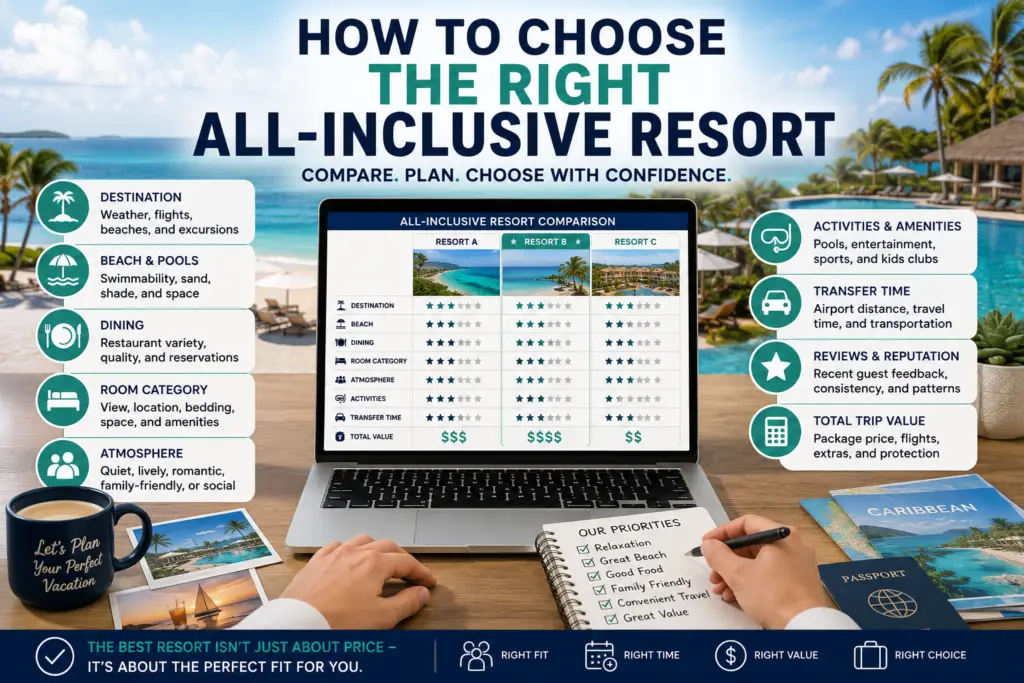
Vacation planning often begins with excitement and quickly turns into dozens of open tabs, conflicting reviews, changing prices, destination comparisons, flight schedules, resort photos, cruise options, and advice from people who want completely different kinds of trips.
The problem is usually not that you need more information. The problem is that too many decisions are open at the same time.
You may be comparing a Caribbean resort against an Alaska cruise, a road trip against a theme park vacation, and several destinations with completely different costs and travel requirements. That makes it almost impossible to feel confident about any single option.
This guide will help you organize an overwhelming vacation search into a manageable sequence, narrow the choices that deserve serious consideration, and recognize when you have enough information to move forward.
This guide is for you if: You have too many vacation ideas, keep reopening the search, cannot get everyone to agree, or worry that choosing one option means missing a better trip somewhere else.
If you are still deciding whether a cruise, resort, road trip, city getaway, guided tour, or custom itinerary fits best, begin with How to Choose the Right Vacation Type.
Why Vacation Planning Becomes Overwhelming
Vacation planning becomes overwhelming when every question feels connected to every other question.
You cannot confidently choose a resort without knowing the destination. You cannot settle on a destination without understanding the flights. You cannot compare flights without dates. You cannot evaluate the complete trip without a realistic budget. When all those questions remain open, the research starts circling instead of progressing.
Common signs that the planning process has become too broad include:
- Opening new options faster than you eliminate old ones
- Comparing trips with completely different purposes
- Changing the budget whenever an attractive option appears
- Reading the same reviews repeatedly without learning anything new
- Asking more people for opinions and becoming less certain
- Restarting the search every time you see a new advertisement
- Trying to plan restaurants and excursions before choosing the main trip
- Waiting for one option with no disadvantages
No vacation is perfect. Every trip involves tradeoffs involving price, travel time, weather, location, schedule, lodging, activities, or flexibility.
The goal is not to eliminate every tradeoff. It is to choose the tradeoffs that your travelers can comfortably accept.
Reduce the Number of Open Decisions
The fastest way to make vacation planning easier is to stop working on every part of the trip simultaneously.
Each major decision should reduce the number of possibilities available during the next step:
- Define the travelers and purpose of the trip.
- Set the dates, budget range, and departure boundaries.
- Choose the general type of vacation.
- Narrow the destination directions.
- Compare a small number of realistic options.
- Choose the best fit and close the search.
You do not need to research restaurant menus before selecting a destination. You do not need to compare every cruise line before deciding that a cruise fits the trip. You do not need to read hundreds of resort reviews when only two properties meet the actual requirements.
Set Five Planning Boundaries Before You Research
Before opening more travel websites, write down five boundaries. These do not need to be perfect, but they must be specific enough to eliminate unrealistic options.
1. Who Is Traveling?
Record the number of travelers, ages of children, mobility considerations, room needs, and any major interests or limitations.
A trip for two adults should not be researched the same way as a multigenerational family vacation. A family with toddlers will evaluate flights, rooms, meals, and activities differently from a family with teenagers.
2. What Dates Actually Work?
Identify whether the dates are fixed, somewhat flexible, or completely open.
Do not begin by looking at every possible month if school, work, sports, weddings, holidays, or other obligations already limit the trip.
The guide to When You Should Book a Vacation explains how lead time changes across different trips and high-demand travel periods.
3. What Is the Realistic Budget Range?
Use a range instead of one rigid number. The range should represent the complete trip, not only the hotel, cruise fare, or advertised package price.
For example, deciding that the complete vacation should remain between $5,000 and $6,000 is more useful than saying you want “something affordable.”
Do not continually raise the budget simply because a new option looks attractive. If the budget changes, make it a conscious decision rather than an accidental result of continued browsing.
4. Which Departure Airports or Driving Distances Are Acceptable?
Decide how far you are willing to drive to an airport and whether connecting flights are acceptable.
For Northwest Ohio travelers, Detroit, Fort Wayne, Cleveland, Columbus, and Indianapolis can create different schedules and prices. Comparing all of them can be useful, but only when the additional driving and parking still make sense.
5. What Must the Trip Accomplish?
Choose the primary purpose of the vacation.
Examples include:
- Rest and reconnect
- Create a memorable family experience
- Celebrate an anniversary or milestone
- Visit several destinations
- Spend time on a good swimming beach
- Experience wildlife, scenery, history, or culture
- Give children or teenagers activities they will enjoy
- Travel with fewer daily decisions
When an option does not support the main purpose, eliminate it even when it looks appealing.
Separate Nonnegotiables From Preferences
Travelers often become stuck because every preference begins to feel like a requirement.
A nonnegotiable is something the trip cannot reasonably succeed without. A preference would improve the experience but can be traded for something more important.
| Nonnegotiable | Preference |
|---|---|
| The room must sleep the family legally and comfortably. | The room would ideally have a particular view. |
| The trip must remain within the complete budget range. | A specific airline or departure time would be preferred. |
| A traveler with mobility needs must be able to navigate the property. | The property would ideally be close to the main pool. |
| The resort must allow children of the travelers’ ages. | The resort would ideally have several specialty restaurants. |
| The flight schedule must work with the cruise departure. | A nonstop flight would be more convenient. |
Try to keep the list of true nonnegotiables short. When every detail is mandatory, no option can survive the comparison.
Use the 3-2-1 Vacation Planning Rule
A simple limit can prevent vacation research from expanding forever:
- Three realistic trip directions
- Two final options
- One decision deadline
Three Realistic Trip Directions
Begin with no more than three destinations or vacation directions that fit the travelers, dates, budget, and main trip purpose.
These should be realistic alternatives, not every trip you might enjoy someday.
For example:
- A family-friendly Caribbean cruise
- An all-inclusive resort in Mexico
- A domestic beach vacation
If those options still represent different vacation types, use the vacation-type guide to settle the direction before researching individual ships, resorts, or hotels.
Two Final Options
After basic research, reduce the search to the two options that fit best.
These may be two resorts, two cruise sailings, two destinations, or two complete itineraries. Both should be options you would genuinely be willing to book.
Do not keep a weak third option merely because you spent time researching it.
One Decision Deadline
Choose a date by which you will either book, request professional help, or pause the trip.
Without a deadline, the search can continue until prices change, preferred rooms disappear, flights worsen, or the planning window becomes unnecessarily tight.
Choose the Vacation Type Before Comparing Specific Trips
One of the biggest sources of planning overwhelm is comparing options that create completely different experiences.
A cruise should not be compared with an all-inclusive resort using only the advertised price. A road trip cannot be compared with an international vacation without considering driving time, flights, meals, lodging, and activities. A guided tour and an independent itinerary offer different levels of control and support.
First decide whether the trip should be built around:
- A cruise
- An all-inclusive resort
- A city or cultural getaway
- A road trip
- A theme park
- A guided tour
- Adventure and nature
- A custom or multi-stop itinerary
The detailed guide to choosing the right vacation type can help you settle that first decision.
Narrow the Destination List to Three or Fewer
Once the vacation type is clear, eliminate destinations that fail the established boundaries.
Ask the same questions about every destination:
- Can it realistically fit the dates?
- Can the complete trip fit the budget range?
- Do the flights or driving requirements make sense?
- Does it support the main purpose of the trip?
- Does it work for the ages and abilities of the travelers?
- Are the important weather or seasonal conditions acceptable?
- Does it provide the experiences that matter most?
An attractive destination that fails two or three major requirements should not remain in the comparison.
Eliminating an option is progress. You are not losing a vacation. You are protecting the trip you are actually planning.
Compare Similar Options Using the Same Criteria
When the shortlist is small, compare every option using the same categories. Do not allow one option to win because you focused on its best feature while focusing on another option’s biggest disadvantage.
| Comparison Category | Question to Answer |
|---|---|
| Traveler Fit | Does this work for the travelers’ ages, interests, room needs, mobility, and preferred pace? |
| Complete Cost | What will the trip realistically cost after transportation, lodging, fees, meals, activities, and expected extras? |
| Travel Day | How difficult are the flights, airport drive, connections, transfers, embarkation, or road time? |
| Lodging or Ship | Does the room, resort, hotel, rental, ship, or cabin support the way you want to travel? |
| Experiences | Does the option provide the activities, scenery, beach, entertainment, food, culture, or relaxation that matters most? |
| Tradeoffs | Which disadvantages come with this option, and are the travelers comfortable accepting them? |
A basic score from one to five can help, but the score should support the discussion rather than replace judgment. A lower score in an unimportant category should not outweigh failure in a true nonnegotiable.
Keep All Research in One Place
Scattered information makes the decision feel harder than it is.
Create one working document, notebook, email thread, or spreadsheet containing:
- Travelers
- Date range
- Budget range
- Departure options
- Nonnegotiables
- Top preferences
- Shortlisted destinations
- Final two options
- Important price inclusions
- Major tradeoffs
- Questions that still require an answer
Remove eliminated options from the working comparison. Keeping every rejected resort, sailing, and destination visible makes the search feel unfinished.
Do Not Let Reviews Control the Entire Decision
Reviews can identify patterns, but they can also make every option look risky.
A traveler who wants quiet may criticize a lively resort that would be perfect for a social group. Someone may dislike a large cruise ship because they prefer intimate travel. One person may consider a beach disappointing while another values the pools, food, and service more.
Use reviews more effectively by looking for:
- Repeated comments rather than one extreme opinion
- Recent patterns instead of isolated older problems
- Reviews from travelers with similar expectations
- Specific observations instead of vague praise or anger
- Issues related to your nonnegotiables
Stop reading once the same strengths and weaknesses begin repeating. At that point, more reviews are unlikely to change the decision.
How Couples and Families Can Resolve Different Preferences
Vacation planning often stalls because the travelers want different things.
One partner may want a quiet beach while the other wants excursions. Parents may want rest while teenagers want activities and independence. Grandparents may value simple transportation while younger travelers want a packed schedule.
Use this process:
- Each traveler names the three things that matter most.
- Each traveler names one genuine dealbreaker.
- Identify the priorities shared by most of the group.
- Choose a trip that offers options instead of forcing identical days.
- Accept that every traveler does not need to participate in every activity.
A strong group vacation does not require complete agreement about every detail. It requires a trip structure that gives different travelers reasonable ways to enjoy themselves.
Decide What Needs Attention Now and What Can Wait
Trying to solve late-stage details before choosing the main trip creates unnecessary stress.
| Research Now | Research Later |
|---|---|
| Travelers, dates, budget, departure options, and vacation type | Detailed packing lists and souvenir ideas |
| Destination fit, weather considerations, and major entry requirements | Every restaurant, menu, and snack option |
| Flight schedule, transportation, lodging, ship, or resort fit | A complete activity schedule for every day |
| Complete price, major inclusions, cancellation terms, and dealbreakers | Minor requests, optional upgrades, and nonessential extras |
Some later details may need advance reservations, but they should not receive attention before the main trip is settled.
Know When You Have Enough Information
Research has done its job when you can answer the important questions about the final options.
You probably have enough information when:
- The option fits the travelers and dates.
- The complete expected cost fits the budget range.
- The travel day is reasonable.
- The major room, resort, cruise, or itinerary details are understood.
- The trip includes the experiences that matter most.
- The main disadvantages are known.
- The travelers are comfortable with those tradeoffs.
- No unresolved issue could make the trip unsuitable.
At this point, additional research often creates doubt without adding meaningful information.
Set Rules for Reopening the Search
After choosing the best option, do not restart the entire comparison because you see a new social media post or receive a random recommendation.
Reopen the search only when something important changes:
- The preferred option is no longer available.
- The price moves outside the approved budget.
- The travel dates change.
- The number or needs of the travelers change.
- A new nonnegotiable is discovered.
- The flights or transportation no longer make sense.
- Reliable new information changes the suitability of the trip.
A different resort photo or one negative review is not automatically a reason to begin again.
What to Do When You Are Stuck Between Two Good Options
If both final choices fit, stop searching for a hidden perfect answer. Compare the tradeoffs directly.
Ask:
- Which option better supports the primary purpose of the trip?
- Which option creates the easier travel day?
- Which option works for more of the travelers?
- Which option offers the experiences we would most regret missing?
- Which option has disadvantages we can more comfortably accept?
- Which option would we feel more confident booking today?
When two options are genuinely strong, the decision may not have one objectively correct answer. Choosing either can be better than delaying until both become more expensive or unavailable.
When Professional Planning Can Reduce the Overwhelm
Professional help can be valuable when the trip has more moving pieces than you want to manage, when you cannot confidently narrow the options, or when the consequences of choosing badly are significant.
This may include:
- International vacations
- Cruises requiring flights and pre-cruise arrangements
- Families needing specific room or activity arrangements
- Group trips with different budgets and preferences
- Anniversaries, honeymoons, and milestone vacations
- All-inclusive resorts that appear similar online
- Trips involving several destinations, transfers, or hotels
- Travelers who do not want to spend weeks comparing options
A useful travel advisor should not add more choices to an already overwhelming search. The advisor should narrow the field, explain the meaningful differences, identify tradeoffs, and help the traveler make a better-informed decision.
The guide to Travel Advisor vs Booking Online can help you decide whether a particular trip is reasonable to handle independently.
Too Many Vacation Options?
Turn the Research Into a Clearer Shortlist
Share who is traveling, your dates, departure airport, budget range, priorities, and what you want the trip to feel like. Sehlmeyer Travel can help narrow the options that genuinely fit instead of sending you another overwhelming list.
Have a quick question first? You can also contact Sehlmeyer Travel.
A 30-Minute Vacation Planning Reset
If your current search feels completely scattered, stop researching and spend 30 minutes resetting the process.
First 10 Minutes: Write the Boundaries
- Who is traveling?
- What dates work?
- What is the complete budget range?
- Which airports or driving distances are acceptable?
- What must the trip accomplish?
Next 10 Minutes: Eliminate Options
Remove every destination, cruise, resort, or itinerary that fails a nonnegotiable, does not fit the budget, creates an unreasonable travel day, or does not support the trip’s main purpose.
Final 10 Minutes: Choose the Next Decision
Do not attempt to finish the whole trip. Choose the next unresolved decision:
- Select the vacation type.
- Narrow the destination list to three.
- Reduce the shortlist to two final options.
- Set a decision deadline.
- Request help with the remaining comparison.
A clear next decision is more useful than another hour of unstructured research.
Final Checklist Before Choosing the Trip
- We know the main purpose of the vacation.
- We have identified the true nonnegotiables.
- The dates and travelers are confirmed.
- The complete expected cost fits the budget range.
- The transportation and travel days are reasonable.
- The lodging, ship, resort, or itinerary fits the travelers.
- We understand the main advantages and disadvantages.
- We have compared no more than two or three serious options.
- No major unresolved question could make the trip unsuitable.
- We have established a deadline for moving forward.
Explore More Travel Planning Guides
- Ultimate Travel Planning Guide
- How to Choose the Right Vacation Type
- When Should You Book a Vacation?
- Travel Advisor vs Booking Online
- Travel Planning Guides
- Travel Guide Library
Final Thoughts on Planning Without Getting Overwhelmed
Vacation planning becomes easier when you stop treating every possible trip as an active option.
Set the boundaries, identify the nonnegotiables, choose the vacation type, narrow the destination list, compare only a small number of realistic options, and establish a deadline for deciding.
You do not need to research every cruise, resort, destination, hotel, flight, or activity. You need enough reliable information to understand the leading choices and their tradeoffs.
A confident decision does not require proving that no better vacation exists. It requires choosing a trip that fits the people traveling and the experience they actually want.
Frequently Asked Questions About Vacation Planning Overwhelm
Why does planning a vacation feel so overwhelming?
Vacation planning becomes overwhelming when too many questions remain open at once. Comparing destinations, vacation types, flights, lodging, budgets, reviews, activities, and documents simultaneously creates more choices than most travelers can evaluate clearly.
How many destinations should I compare?
Compare no more than three realistic destination directions at one time. Each should fit the travelers, dates, budget range, transportation limits, and primary purpose of the trip.
How many resorts, cruises, or hotels should I seriously compare?
A final shortlist of two or three serious options is usually enough. Every option should meet the important requirements and be something you would genuinely consider booking.
How do I stop overthinking a vacation decision?
Identify your nonnegotiables, compare the final options using the same criteria, accept that every trip has tradeoffs, and set a deadline for deciding. Reopen the search only when an important circumstance changes.
How do couples choose a vacation when they want different things?
Each traveler should identify three priorities and one true dealbreaker. Look for a trip that supports the shared priorities and allows some independent activities rather than requiring both travelers to follow the same schedule every day.
When should I stop reading travel reviews?
Stop when the same strengths and weaknesses begin repeating and you understand the issues related to your nonnegotiables. Additional reviews often create doubt without adding new information.
What should I research first when planning a vacation?
Start with the travelers, dates, complete budget range, acceptable departure options, trip purpose, and general vacation type. Detailed restaurants, excursions, packing, and optional upgrades can wait until the main trip is selected.
When should I consider using a travel advisor?
Professional guidance may help when the trip has several moving pieces, the options appear difficult to distinguish, the travelers have different needs, or you do not want to spend significant time researching cruises, resorts, flights, and destinations independently.