A travel documents checklist may not be the most exciting part of vacation planning, but it can determine whether the trip begins at all.
A beautiful resort, ideal cruise itinerary, convenient flight, or carefully planned family vacation will not help if a passport is expired, the traveler’s name is incorrect, a required visa is missing, or the wrong identification is brought to the airport.
Document requirements can also differ based on citizenship, destination, age, transportation method, cruise itinerary, legal residency, and whether a child is traveling with both parents.
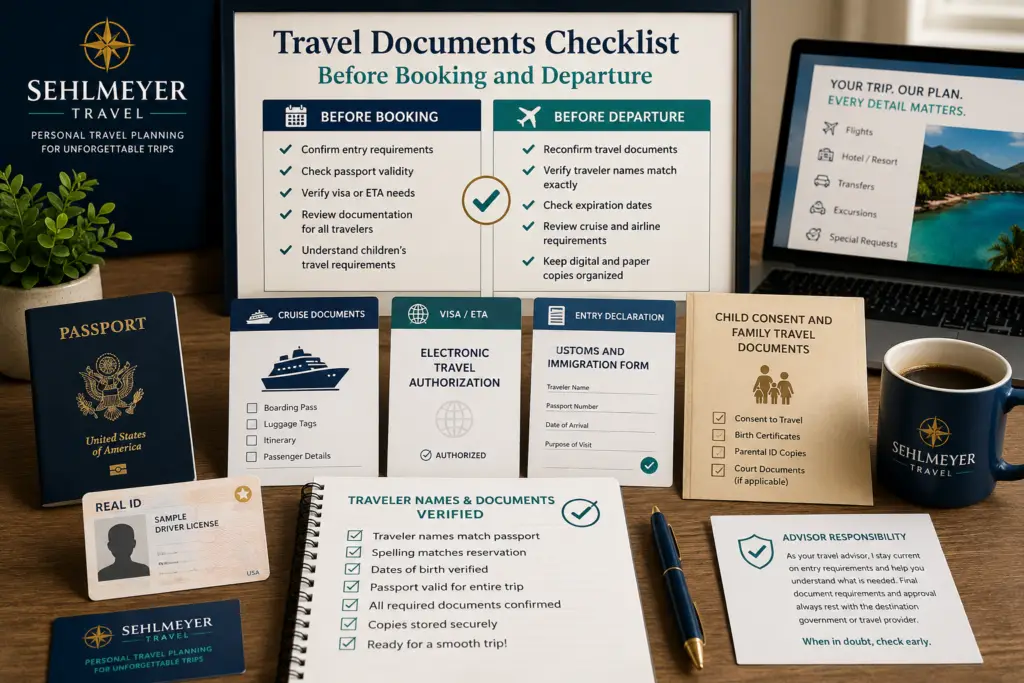
This travel documents checklist will help you identify what to verify before booking, what to recheck before departure, and which official sources should provide the final answer for your particular trip.
Important: Sehlmeyer Travel can help organize document questions and direct travelers to official resources. However, government authorities, airlines, cruise lines, and destination officials determine whether a traveler’s documents are acceptable.
Requirements can change between booking and departure. Always verify current rules through official government sources and the suppliers operating your trip.
Travel Documents Checklist: What Should You Check First?
Before paying a deposit or purchasing nonrefundable travel, confirm the basic document situation for every traveler.
- What citizenship or nationalities does each traveler hold?
- Is each traveler flying domestically, internationally, cruising, or crossing a land border?
- Does every traveler have the correct type of passport or identification?
- Will each passport remain valid long enough for the destination’s rules?
- Does the destination require a visa or electronic travel authorization?
- Does the destination require an arrival, immigration, health, or customs form?
- Do the reservation names match the travelers’ government-issued documents?
- Are children traveling with both parents, one parent, grandparents, or another adult?
- Does a permanent resident or dual national need additional documents?
- Does the airline or cruise line impose requirements beyond the minimum government rules?
Do not assume every traveler in the same family has the same requirements. Citizenship, age, passport type, and legal relationship can change the answer.
Three Times to Verify Travel Documents
A strong document check is not a one-time task. Review the requirements at three points in the planning process.
| Verification Point | What to Check | Why It Matters |
|---|---|---|
| Before Booking | Passport type, expiration, legal names, visas, child documents, and major entry requirements | Document problems may affect whether the trip should be booked or which cancellation terms are reasonable. |
| Before Final Payment | Passport status, visa progress, traveler names, itinerary changes, and supplier requirements | A change in itinerary or destination can create a new requirement. |
| Before Departure | Entry forms, approvals, boarding documents, original IDs, secure copies, and current official rules | The documents must be complete, current, accessible, and carried in the correct bag. |
Quick Travel Document Decision Guide
| Document | When It May Apply | What to Verify |
|---|---|---|
| REAL ID or TSA-Accepted ID | Adults flying within the United States | Expiration, physical condition, name, and whether the document appears on TSA’s current accepted-ID list |
| Passport Book | International air travel and many international cruises | Expiration, destination validity rules, condition, blank-page requirements, and legal name |
| Passport Card | Certain land and sea travel and domestic air identification | Whether the trip includes international air travel, for which the card is not valid |
| Visa or Electronic Authorization | Destinations requiring advance travel permission based on nationality and trip purpose | Application method, approval status, validity dates, entry limits, processing time, and passport association |
| Entry or Customs Form | Countries requiring an online or physical arrival declaration | Official website, completion window, fee, traveler information, and confirmation receipt |
| Cruise Boarding Documents | Cruise check-in and embarkation | Cruise-line requirements, itinerary rules, passport or citizenship documents, and completed online check-in |
| Child Consent or Custody Documents | A minor traveling without one or both parents or legal guardians | Destination, airline, cruise-line, custody, and notarization requirements |
| Permanent Resident Card | U.S. lawful permanent residents returning to the United States | Card validity, foreign passport requirements, destination visa rules, and trip duration |
| Supporting Medical Documents | Prescription medication, medical devices, accessibility needs, or destination health requirements | Original labels, prescriptions, physician letters, import rules, and permitted quantities |
REAL ID and Domestic Flight Identification
REAL ID enforcement began on May 7, 2025.
Adult passengers age 18 and older flying within the United States must present a REAL ID-compliant driver’s license or another identification document accepted by the Transportation Security Administration.
Accepted alternatives may include a valid passport book, passport card, or another document on TSA’s current list.
Before a domestic flight, verify:
- Every adult has an acceptable physical identification document.
- The identification has not expired.
- The name is consistent with the airline reservation.
- The document is not severely damaged.
- The traveler understands that a temporary paper license may not be accepted by itself.
- The identification will remain in a carry-on, wallet, or personal item.
TSA generally does not require children under age 18 to show identification for domestic travel. However, airlines may maintain their own age-verification or identification policies.
Review TSA’s current acceptable identification list before departure.
Does REAL ID Replace a Passport?
No.
REAL ID applies primarily to domestic identification requirements. It does not replace a passport book for international air travel.
A traveler flying from the United States to Mexico, Canada, Europe, or most Caribbean destinations should expect to need a valid passport book unless an official exception applies.
A valid passport book or card may serve as acceptable identification at a domestic TSA checkpoint. However, that does not mean both passport types have the same international travel privileges.
Passport Book vs Passport Card
The passport book and passport card both confirm U.S. citizenship and identity, but they cannot be used for all the same trips.
| Travel Use | Passport Book | Passport Card |
|---|---|---|
| International Air Travel | Valid when other entry requirements are met | Not valid |
| Domestic Air Identification | Accepted | Accepted |
| Land and Sea Travel | Broadly usable when destination requirements are met | Limited to qualifying travel involving Canada, Mexico, Bermuda, and Caribbean destinations |
| Visa Pages | Yes | No |
| Unexpected International Flight Home | Can be used when valid | Cannot be used for international air travel |
Travelers can review the State Department’s official passport book and card comparison.
Passport Checklist Before International Travel
Do not look only at the expiration date.
Review the complete condition and suitability of each passport:
- Is it a passport book when international air travel is involved?
- Will it remain valid for the destination’s required period?
- Does the passport have any serious water damage, tears, missing pages, or physical alterations?
- Are enough blank pages available if the destination requires them?
- Is the traveler’s current legal name shown correctly?
- Does the photograph still reasonably identify the traveler?
- Has the passport ever been reported lost or stolen?
- Does every child have a valid individual passport when required?
Once a passport is reported lost or stolen, it cannot be used again—even if it is later found.
How Much Passport Validity Do You Need?
There is no universal rule that every destination requires six months of passport validity.
Some countries require the passport to remain valid only during the visit. Others require additional validity beyond the planned departure date. That extra period may be three months, six months, or another destination-specific requirement.
Airlines may deny boarding when the passport does not satisfy the destination’s entry rules.
Check the destination’s entry and exit requirements through the State Department’s official international travel information and the destination government’s official website.
Do not wait until online check-in: Check passport expiration and destination validity rules before placing major nonrefundable deposits.
Adult and Child Passport Validity
U.S. passport validity depends partly on the traveler’s age when the document was issued.
- Passports issued to children under age 16 are generally valid for five years.
- Passports issued at age 16 or older are generally valid for ten years.
- Children under 16 cannot use the normal adult renewal process and generally must apply again.
- Travelers age 16 and 17 follow a different application process from younger children.
Parents should not assume a child’s passport remains valid as long as an adult passport.
Review official State Department guidance for children under 16 and travelers age 16 or 17.
Visas and Electronic Travel Authorizations
A passport allows a traveler to request entry. It does not automatically provide permission to enter every country.
Depending on nationality, destination, trip length, and reason for travel, a traveler may need:
- A traditional visa issued before travel
- An electronic visa
- An electronic travel authorization
- A visa on arrival
- A transit visa for a connecting country
- Different permission for work, study, volunteering, or an extended stay
Before booking, verify:
- Whether every traveler needs a visa or authorization
- Whether children need separate approvals
- How early an application may be submitted
- How long the approval remains valid
- Whether the authorization permits multiple entries
- Whether it is electronically linked to one passport
- Whether a new passport requires a new authorization
- Whether a transit country creates an additional requirement
Use the destination’s official immigration or embassy website. U.S. citizens can also review the destination’s entry, exit, and visa section through the State Department’s country information.
Be cautious with third-party websites that imitate official visa or authorization pages and charge unnecessary service fees.
Entry Forms, Arrival Declarations and Customs Documents
Some destinations require an online or physical form in addition to a passport and visa.
The form may collect:
- Passport details
- Flight or cruise information
- Arrival and departure dates
- Hotel or resort address
- Contact information
- Customs declarations
- Health or security information
- Details about goods being carried
Confirm:
- The correct official website
- Whether the form is free
- How many days before arrival it can be completed
- Whether each traveler needs a separate submission
- Whether a confirmation code or QR code must be saved
- Whether departure information is also required
- Whether the airline will verify completion before boarding
Do not complete a destination form months early unless the official instructions allow it. Some forms must be completed within a specific window.
Jamaica C5 Declaration
Jamaica’s Immigration/Customs C5 declaration is a practical example of an arrival requirement that exists separately from the flight and resort reservation.
Travelers entering Jamaica should review the current official requirements, complete the required declaration as directed, and save any confirmation provided.
Use Jamaica’s Passport, Immigration and Citizenship Agency page for the current travel-document and C5 requirements.
For destination planning beyond the entry process, continue with the Jamaica Travel Guide.
Travel Documents for Cruises
Cruise-document questions require extra care because the answer may depend on:
- Traveler citizenship
- Departure port
- Return port
- Ports visited
- Whether the cruise begins and ends at the same U.S. port
- Whether the itinerary requires international flights
- Cruise-line rules
- Age of the traveler
- Permanent-residency status
Some U.S. citizens on certain qualifying closed-loop cruises may be permitted to travel with approved proof of citizenship and government-issued identification instead of a passport book.
However, that is not a universal rule for every cruise, port, traveler, or cruise line.
Why a Passport Book Is Often the Stronger Cruise Document
Even when alternative documentation may satisfy the minimum rule, a passport book provides greater flexibility.
That can matter if a traveler must:
- Fly to meet the ship after missing embarkation
- Leave the cruise early
- Return home from a foreign port
- Handle a medical emergency
- Respond to an itinerary disruption
A birth certificate or passport card does not provide the same international air-travel flexibility as a passport book.
Review official Customs and Border Protection cruise-document guidance and the cruise line’s requirements for the exact sailing.
Cruise Boarding Documents
Before embarkation, travelers may need:
- Passport or other approved citizenship and identification documents
- Cruise boarding pass
- Completed online check-in
- Arrival-time selection
- Health or destination declarations when required
- Visa or travel-authorization approval
- Documents required for minors
- Payment method for the onboard account
Keep all original identification and boarding documents in the embarkation-day carry-on. Never place passports or required boarding documents in luggage handed to porters.
The Cruise Packing Guide explains what else belongs in the carry-on.
Travel Documents for Children
Every child needs the documents required for the exact trip. A child’s age does not automatically exempt the child from international documentation rules.
Depending on the itinerary, families may need to review:
- Passport book
- Passport expiration
- Birth certificate
- Visa or travel authorization
- Entry declaration
- Proof of legal relationship
- Consent letter
- Custody or guardianship order
- Adoption documentation
- Airline age-verification requirements
- Cruise-line documentation rules
Bring documentation for each child rather than assuming one family document covers everyone.
Children Traveling With One Parent or Another Adult
Some countries require additional documentation when a minor travels without both parents or legal guardians.
This may include:
- A signed consent letter from the nontraveling parent
- A notarized consent letter
- A copy of the child’s birth certificate
- Proof of sole custody
- A death certificate for a deceased parent
- Guardianship documents
- Information about the trip and responsible adult
The requirement may apply when a child travels:
- With one parent
- With grandparents
- With another family
- With a school, sports team, or tour group
- Without either legal guardian
There is no single consent form accepted universally by every destination.
Review the destination, airline, cruise-line, custody, and legal requirements. The State Department provides official guidance for international travel with minors.
Lawful Permanent Residents and Non-U.S. Citizens
A U.S. Permanent Resident Card does not automatically replace a passport or visa for entering another country.
Lawful permanent residents should verify:
- Documents required to reenter the United States
- Whether the Permanent Resident Card will remain valid
- Whether the destination requires a valid passport from the traveler’s country of citizenship
- Whether a destination visa is required
- Whether a lengthy trip could affect U.S. residency considerations
- Whether special rules apply to refugee, asylee, or other immigration status
Customs and Border Protection explains that lawful permanent residents generally use their permanent-resident documentation when returning to the United States, while the foreign destination may separately require a passport or visa.
Review current CBP guidance for lawful permanent residents and consult the destination’s official authorities.
Dual Nationals May Need More Than One Passport
Travelers who hold citizenship in more than one country may face special entry and exit rules.
A country may require its citizens to enter or leave using that country’s passport. U.S. citizens, including dual nationals, are generally required to enter and leave the United States using a U.S. passport.
Before travel, dual nationals should review:
- Which passport must be used to enter the destination
- Which passport must be used to leave the destination
- Which passport information should appear in the airline reservation
- Whether a visa is required on either passport
- Whether children automatically hold another nationality
- Whether the foreign country places restrictions on dual nationals
The State Department provides additional guidance on traveling with dual nationality.
Names and Traveler Information Must Be Accurate
Travel reservations should use the traveler information required by the airline, cruise line, resort supplier, and government documents.
Before approving a reservation, verify:
- First name
- Middle name or initial when requested
- Last name
- Suffix when applicable
- Date of birth
- Citizenship
- Passport number
- Passport issue and expiration dates
- Known Traveler Number when used
- Frequent-flyer number when used
Avoid entering a nickname when the supplier requires the legal document name.
For example, do not assume that “Matt” should be used when the passport says “Matthew.” Follow the supplier’s naming instructions and review the confirmation immediately after booking.
Name Changes
Travelers with a recent marriage, divorce, adoption, or court-ordered name change should confirm which name appears on each document.
A passport, airline reservation, Permanent Resident Card, driver’s license, and supporting legal document may not all update at the same time.
Do not assume that bringing a marriage certificate automatically fixes every mismatch. Contact the appropriate supplier and government authority before travel.
Medical and Medication Documents
Some medications that are legal in the United States are restricted or prohibited elsewhere.
Travelers carrying prescription medication, injectable medication, controlled substances, or medical devices should consider:
- Keeping medicine in its original labeled container
- Carrying a copy of the prescription
- Obtaining a physician’s letter when appropriate
- Checking the destination’s medication-import rules
- Confirming airline rules for needles, liquids, oxygen, batteries, or medical equipment
- Keeping essential medication in the carry-on
- Bringing enough medication for the trip and reasonable disruption time
Do not place essential medication in checked luggage.
What Travel Documents Should You Print or Save?
Digital access is convenient, but phones can lose power, internet access can fail, and apps can become unavailable.
Consider carrying printed or offline copies of:
- Flight itinerary
- Cruise boarding documents
- Resort or hotel confirmation
- Transfer confirmation
- Travel-protection policy and emergency contacts
- Visa or authorization approval
- Entry-form confirmation
- Excursion confirmations
- Medication list
- Emergency contacts
- Important supplier phone numbers
For international travel, consider keeping a copy of the passport information page separate from the original.
Store digital copies securely. Do not leave unprotected passport images or personal information in public cloud folders, shared photo albums, or unsecured email accounts.
What to Do If a Passport Is Lost or Stolen
Report a valid lost or stolen U.S. passport promptly.
Once reported, the passport is canceled and cannot be used again—even if it is found later.
If the loss occurs abroad:
- Contact the nearest U.S. embassy or consulate.
- Follow the State Department’s reporting instructions.
- Prepare identification and proof of citizenship when available.
- Adjust flights or other travel arrangements only after understanding the replacement process.
- Contact the travel-protection provider when the policy may apply.
Review the State Department’s official instructions for a lost or stolen passport abroad.
Travel Document Checklist Before Booking
- List every traveler’s citizenship and residency status.
- Inspect every passport and identification document.
- Confirm the correct passport type for the transportation method.
- Check destination-specific passport-validity rules.
- Review visa and electronic-authorization requirements.
- Review cruise-line documentation rules when applicable.
- Identify child-consent or custody concerns.
- Confirm every traveler’s legal name and birth date.
- Consider refundable options when an important document is unresolved.
- Save the official government sources used for verification.
Travel Document Checklist Before Final Payment
- Confirm that required passport applications or renewals are complete.
- Check that received passports contain correct information.
- Confirm visa or authorization progress.
- Review the final itinerary for new countries or transit points.
- Recheck cruise-line and airline requirements.
- Confirm names, dates of birth, and passport details in supplier records.
- Review documents required for minors.
- Confirm permanent-resident or dual-national requirements.
Travel Document Checklist 30 Days Before Departure
- Inspect passports and accepted IDs again.
- Confirm all visas and travel authorizations.
- Review destination entry and exit requirements.
- Check for required arrival or customs forms.
- Confirm airline or cruise online check-in dates.
- Prepare consent, custody, or relationship documents for minors.
- Organize medication documentation.
- Save travel-protection details and emergency numbers.
- Create secure copies of important documents.
Travel Document Checklist Seven Days Before Departure
- Complete entry declarations that fall within the permitted window.
- Download airline, cruise-line, and supplier apps.
- Save boarding documents for offline access.
- Print critical confirmations.
- Place original documents together in a secure travel organizer.
- Confirm every traveler knows where required documents will be carried.
- Review current official requirements one final time.
Travel-Day Document Checklist
Before leaving home, physically confirm that you have:
- Passport books or accepted identification
- Permanent Resident Cards when applicable
- Visas and authorization approvals
- Entry-form confirmations
- Airline or cruise boarding documents
- Child consent or custody documents
- Medication and medical documentation
- Travel-protection information
- Transfer and lodging confirmations
- Emergency contact details
Keep these documents in a carry-on or personal item that remains under your control.
Common Travel Document Mistakes
Checking the Passport Only After Booking
A document problem may affect whether the destination, dates, or nonrefundable terms are reasonable.
Assuming Six Months Is Always the Rule
Passport-validity requirements differ by destination. Verify the exact country rule.
Using a Passport Card for International Air Travel
A passport card is not valid for international flights.
Assuming REAL ID Is a Passport
REAL ID may satisfy domestic identification requirements but does not replace a passport book for international air travel.
Assuming Every Closed-Loop Cruise Has the Same Rules
Cruise documentation depends on the itinerary, citizenship, ports, traveler, and cruise line.
Forgetting That Children Need Documents
Children may need individual passports, visas, entry forms, birth certificates, consent letters, or custody documentation.
Using a Nickname on the Reservation
Use the traveler information required by the supplier and government document.
Using an Unofficial Visa or Entry-Form Website
Third-party websites may charge unnecessary fees, collect sensitive information, or submit the wrong form.
Placing Passports in Checked Luggage
Required identification must remain accessible during check-in, security, border processing, and embarkation.
Assuming Requirements Cannot Change
Entry rules should be checked again before departure—even when they were reviewed during booking.
How Sehlmeyer Travel Helps With Document Preparation
Matt can help clients organize the document-verification process as part of the larger vacation plan.
Sehlmeyer Travel may help by:
- Reminding travelers to check passports before booking
- Identifying document categories that may apply
- Flagging obvious expiration or name concerns
- Providing cruise-line or supplier check-in reminders
- Directing travelers toward official government sources
- Helping organize entry-form timing
- Reviewing whether itinerary changes create new questions
- Keeping document preparation connected to the rest of the trip
However, a travel advisor does not issue passports, approve visas, provide immigration or legal advice, or decide whether a traveler will be admitted.
Each traveler remains responsible for obtaining valid documents and satisfying the official requirements for the itinerary.
For a broader view of Matt’s role before and after booking, read Personalized Vacation Planning With Sehlmeyer Travel.
Check the Details Before They Become Problems
Build the Trip Around Travelers Who Are Ready to Go
Share your travelers, dates, departure airport, destination ideas, and document concerns. Sehlmeyer Travel can help organize the planning process and identify which official requirements need your attention.
Have a quick question first? You can also contact Sehlmeyer Travel.
Official Travel Document Resources
- TSA Acceptable Identification
- TSA REAL ID Information
- U.S. Passport Information
- State Department Destination Requirements
- State Department International Travel Checklist
- CBP Cruise Document Guidance
Explore More Travel Planning Guides
- Ultimate Travel Planning Guide
- When Should You Book a Vacation?
- Travel Insurance Explained
- Cruise Packing Guide
- Family Vacation Planning Checklist
- Travel Advisor vs Booking Online
- Travel Planning Guides
- Travel Guide Library
Final Thoughts on Travel Documents
Travel documents are easy to overlook because they do not feel like the vacation itself.
However, they are the foundation that allows the vacation to happen.
Check the passport type, expiration, condition, and destination validity rules. Confirm REAL ID or another accepted document for domestic flights. Review visas, electronic authorizations, cruise rules, entry forms, child-travel documents, permanent-residency requirements, and traveler names.
Then check everything again before departure.
The safest answer is not the one found in an old social-media comment, a past traveler’s experience, or a rule that applied to a different itinerary.
The safest answer comes from the current official source for the exact traveler and trip.
Frequently Asked Questions About Travel Documents
What travel documents should I check before booking?
Check passports, passport validity, REAL ID or other accepted domestic identification, visas, electronic travel authorizations, cruise requirements, entry forms, traveler names, child documents, and residency-related requirements.
Do I need a passport for international air travel?
U.S. citizens generally need a valid passport book for international air travel. A passport card is not valid for international flights.
Does REAL ID replace a passport?
No. REAL ID may be used for domestic identification, but it does not replace a passport book for international air travel.
Can I use a passport instead of REAL ID for a domestic flight?
Yes. A valid passport book or passport card is generally accepted by TSA as domestic air-travel identification.
Do children need identification for domestic flights?
TSA generally does not require identification from children under age 18 for domestic travel. Airlines may have their own age or identification requirements.
How long must my passport remain valid?
The rule depends on the destination. Some countries require validity only during the trip, while others require additional validity beyond the departure date. Check the exact country requirements.
Do children need passports?
Children generally need their own passport books for international air travel. Cruise, land-border, and destination requirements may differ, so verify the exact itinerary.
How long is a child’s passport valid?
A U.S. passport issued to a child under age 16 is generally valid for five years. Passports issued at age 16 or older are generally valid for ten years.
Do I need a passport for a closed-loop cruise?
Some U.S. citizens on qualifying closed-loop cruises may be permitted to use alternative citizenship and identification documents. However, requirements vary, and a passport book provides more flexibility if international air travel becomes necessary.
Do I need a visa if I have a passport?
Possibly. Visa and electronic-authorization requirements depend on nationality, destination, trip length, and purpose. A passport alone does not guarantee entry.
Do I need a consent letter to travel with my child?
Some destinations require a consent letter or proof of custody when a child travels without one or both parents. Check destination, airline, cruise-line, and legal requirements.
Should my airline ticket match my passport?
The traveler information should follow the airline’s instructions and be consistent with the government identification used for travel. Contact the supplier promptly if an error is discovered.
What documents do lawful permanent residents need?
A lawful permanent resident may need a valid Permanent Resident Card to return to the United States and a passport or visa to enter the foreign destination. Requirements depend on the trip and citizenship.
What should dual nationals check?
Dual nationals should verify which passport each country requires for entry and exit. U.S. citizens generally must enter and leave the United States using a U.S. passport.
Should I carry printed copies of my travel documents?
It is wise to have offline or printed access to important confirmations, approvals, emergency numbers, and travel-protection details. Keep passport copies separate from the originals and store digital information securely.
Can a travel advisor confirm that my documents guarantee entry?
No. A travel advisor can help organize questions and direct travelers to official sources, but government and border authorities make the final entry decision.