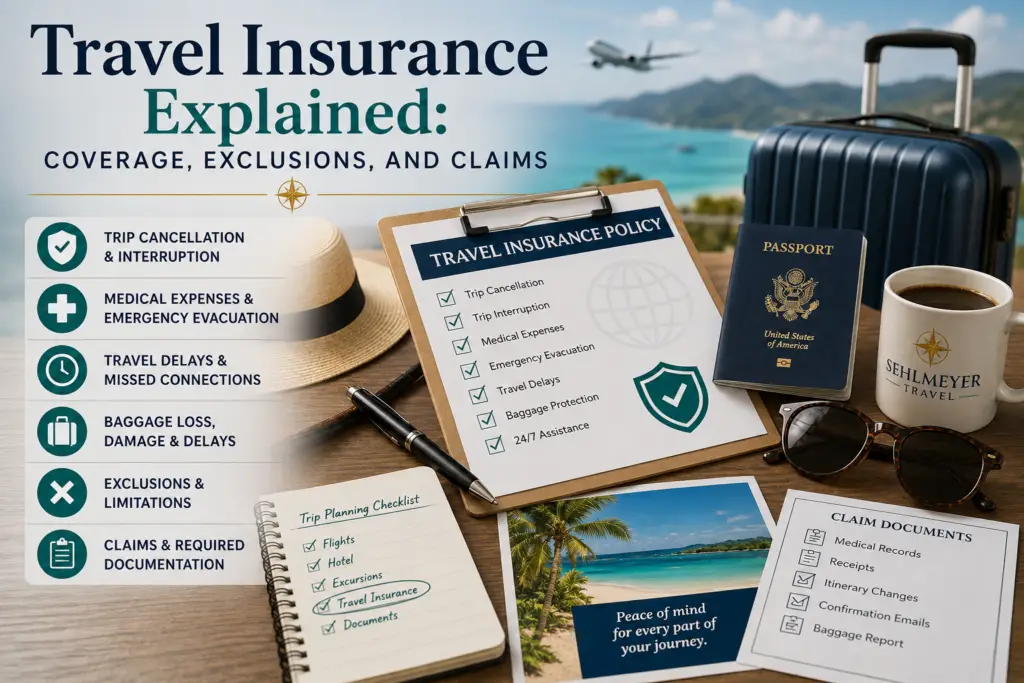
Travel insurance is one of those vacation details that can feel unimportant until something goes wrong. Someone gets sick before departure. A flight delay causes a missed cruise connection. A bag does not arrive. A family emergency cuts the trip short. A traveler needs medical care far from home.
That is when the details of the policy matter.
Travel insurance may help protect certain prepaid trip costs and unexpected expenses when a covered event occurs. However, it is not a universal refund policy. Every plan has its own covered reasons, exclusions, limits, deadlines, documentation requirements, and claim procedures.
This travel insurance explained guide breaks down what a policy may cover, what commonly may not be covered, how supplier cancellation rules differ from insurance, and what travelers should examine before choosing a plan.
Important: This article provides general travel-planning education. It is not legal, financial, medical, or insurance advice. The actual policy wording controls coverage, eligibility, exclusions, reimbursement, and claim decisions. Review the policy documents and contact the insurance provider with coverage questions.
What Is Travel Insurance?
Travel insurance is a policy that may provide financial protection for certain travel-related losses before or during a trip.
Depending on the plan, benefits may include:
- Trip cancellation
- Trip interruption
- Travel delay
- Missed connections
- Travel medical expenses
- Emergency medical evacuation
- Baggage loss, damage, or delay
- Other policy-specific benefits
The most important words are covered reason. A loss normally must meet the policy’s definition of a covered event, and the traveler must satisfy the policy requirements.
The National Association of Insurance Commissioners explains that every travel insurance policy sets its own coverage limits and identifies the situations it will and will not cover.
Do Not Confuse These Three Different Products
Travelers often use the words insurance, protection, waiver, and cancellation policy interchangeably. They are not necessarily the same thing.
| Product or Rule | What It Controls | What to Examine |
|---|---|---|
| Supplier Cancellation Policy | What the airline, resort, cruise line, tour operator, or hotel will refund, credit, penalize, or retain if plans change. | Deposit rules, final payment dates, change fees, cancellation penalties, and whether payments are refundable. |
| Travel Insurance Policy | Whether certain covered losses may be reimbursed under a contract issued by an insurer. | Covered reasons, exclusions, limits, effective dates, eligibility rules, and claim requirements. |
| Cancellation Waiver or Assistance Service | May waive certain supplier penalties or provide services such as referrals, translation help, or travel assistance. | Whether it is actually insurance, whether reimbursement is cash or credit, and which situations or fees qualify. |
A supplier waiver may be useful, but it may not include medical treatment, evacuation, baggage benefits, or the consumer protections of an insurance policy. Read what is being offered rather than relying only on the words “travel protection.”
What Travel Insurance May Cover
Coverage varies, but comprehensive travel insurance plans may combine several types of benefits.
| Benefit | What It May Address | What to Check |
|---|---|---|
| Trip Cancellation | Eligible prepaid, nonrefundable costs when the trip is canceled before departure for a covered reason. | Covered reasons, maximum benefit, required documentation, and insured trip cost. |
| Trip Interruption | Certain unused trip costs or additional transportation when a covered event interrupts a trip after departure. | Interruption reasons, reimbursement limits, return transportation rules, and eligible expenses. |
| Travel Delay | Eligible meals, lodging, transportation, or necessities during a qualifying delay. | Required delay length, covered causes, daily limit, total limit, and receipts. |
| Missed Connection | Certain costs when a covered delay causes a traveler to miss a cruise, tour, or connecting departure. | Qualifying delay, connection requirements, eligible transportation, and maximum benefit. |
| Travel Medical | Eligible short-term medical treatment for a covered illness or injury while traveling. | Primary or secondary coverage, deductibles, exclusions, provider approval, and direct payment versus reimbursement. |
| Emergency Medical Evacuation | Covered transportation to an appropriate medical facility and, when included, additional medically necessary transportation. | Who authorizes transportation, destination of transport, limits, and whether returning home is included. |
| Baggage Loss or Damage | Eligible loss, theft, or damage involving luggage or personal belongings. | Per-item limits, excluded belongings, depreciation, other available reimbursement, and reporting requirements. |
| Baggage Delay | Eligible necessities purchased while checked luggage is delayed. | Required delay period, covered purchases, benefit limit, airline report, and receipts. |
Trip Cancellation Coverage
Trip cancellation coverage may reimburse certain prepaid, nonrefundable trip expenses when a traveler cancels before departure for a covered reason listed in the policy.
Depending on the plan, covered reasons may include specific illnesses, injuries, deaths, natural disasters, severe weather events, jury duty, or other defined circumstances.
A standard cancellation benefit does not normally mean that the traveler can cancel simply because:
- The traveler changed their mind.
- The price dropped after booking.
- The forecast looks unpleasant.
- The traveler no longer likes the destination.
- A work schedule changed for a reason not covered by the policy.
- The traveler is nervous about going.
A claim may be denied when the cancellation reason does not meet the policy definition, even when the traveler’s situation is understandable.
Trip Interruption Coverage
Trip interruption applies after travel has begun. It may help when a covered event forces a traveler to miss part of the trip, leave early, or make new transportation arrangements.
For example, a traveler may become seriously ill during a cruise, or a covered family emergency may require an early return home. Depending on the policy, interruption benefits may address certain unused trip costs and eligible additional transportation.
Do not assume the interruption benefit automatically pays for every lost night, missed activity, new flight, or upgraded seat. Review what expenses qualify and how the policy calculates reimbursement.
Travel Delay and Missed Connection Coverage
Travel delay coverage may help with reasonable, eligible expenses after a delay meets the policy’s required length and covered cause.
Possible expenses may include:
- Meals
- A hotel stay
- Local transportation
- Essential personal items
Policies may include a per-day limit, a total maximum, and specific documentation requirements.
Missed connection coverage is separate and may be particularly important when a flight delay causes a traveler to miss a cruise or scheduled tour departure. It may help with certain transportation or accommodation expenses, but only when the policy conditions are met.
Good planning still matters: Insurance does not replace a sensible itinerary. When flying to a cruise, arriving the day before embarkation can reduce the risk that one flight problem causes you to miss the ship. Read Why You Should Fly to Your Cruise a Day Early.
Travel Medical Coverage
Travel medical insurance may help pay eligible short-term medical expenses when a traveler becomes ill or injured during a covered trip.
This deserves careful attention during international travel. A regular U.S. health plan may provide limited overseas coverage, require the traveler to pay first, restrict providers, or offer no useful international benefits.
The U.S. Department of State recommends checking whether your regular health insurance covers emergency and routine care abroad. It also explains that trip-cancellation insurance does not necessarily cover overseas medical bills.
Travelers covered by Medicare should not assume that regular benefits travel with them. Medicare generally provides limited coverage outside the United States, with specific exceptions.
Questions to Ask About Travel Medical Coverage
- Is the benefit primary or secondary to my regular insurance?
- Must I contact the insurer before receiving treatment?
- Will the provider be paid directly, or must I seek reimbursement?
- What deductible or coinsurance applies?
- What is the medical benefit limit?
- Are certain destinations or activities excluded?
- How are pre-existing medical conditions handled?
- Is there a 24-hour emergency assistance number?
Emergency Medical Evacuation Is Not the Same as Medical Treatment
Medical coverage may address eligible treatment. Medical evacuation coverage may address eligible transportation.
Depending on the policy, evacuation benefits may help transport a traveler to the nearest appropriate medical facility. Some plans may also provide additional transportation when medically necessary and approved.
Travelers should not assume that “evacuation” automatically means a private flight directly home. The insurer, assistance provider, treating physicians, policy wording, and medical necessity may all affect what is authorized.
This benefit deserves close attention for:
- Cruises
- Remote islands
- Expedition travel
- International road trips
- Adventure vacations
- Destinations with limited medical facilities
Baggage Loss, Damage, and Delay
Baggage benefits may help when checked luggage or personal belongings are lost, stolen, damaged, or delayed.
However, the maximum baggage benefit is not necessarily the amount available for every individual item. Policies may have lower sublimits for electronics, jewelry, cameras, sports equipment, or other valuables.
A traveler may also need to pursue reimbursement from the airline, cruise line, credit card, homeowners insurer, or another responsible party before the travel policy pays.
When luggage is delayed:
- Report it to the airline or transportation provider immediately.
- Obtain a written baggage report or tracking number.
- Purchase only reasonable necessities.
- Keep every receipt.
- Confirm when the policy’s delay benefit begins.
Keep passports, medication, medical devices, valuables, boarding documents, and first-day necessities in your carry-on. The Cruise Packing Guide explains what should remain with you during cruise embarkation.
What Is Cancel For Any Reason Coverage?
Cancel For Any Reason coverage, commonly called CFAR, may provide additional flexibility when the reason for canceling is not covered by standard trip-cancellation insurance.
CFAR is usually an optional upgrade rather than a stand-alone replacement for normal cancellation coverage.
Common characteristics may include:
- A requirement to purchase within a policy-defined period after the first trip payment
- A requirement to insure eligible prepaid, nonrefundable trip costs
- A cancellation deadline before the scheduled departure
- Reimbursement of only a portion of the insured trip cost
- Additional premium
CFAR does not normally mean a full refund for any reason at any time. Read the eligibility conditions carefully before relying on it.
Pre-Existing Medical Conditions and Time-Sensitive Benefits
Some policies exclude losses connected to pre-existing medical conditions. Other plans may offer a waiver of that exclusion when specific eligibility requirements are satisfied.
Possible requirements may involve:
- Purchasing the policy within a specified period after the initial trip payment
- Insuring required prepaid, nonrefundable trip costs
- Meeting health or eligibility conditions defined by the policy
- Updating the insured trip cost when additional nonrefundable expenses are added
Do not assume that buying a policy automatically waives the pre-existing-condition exclusion. Look for the exact policy language and confirm the eligibility requirements directly with the provider.
Other benefits, including CFAR, may also be time-sensitive. That is one reason travel insurance should be discussed soon after the first trip deposit rather than shortly before departure.
Insure the Correct Trip Cost
The trip cost entered on an insurance application can affect the premium, benefits, and eligibility for certain provisions.
Start by identifying which trip payments are:
- Prepaid
- Nonrefundable
- Subject to a cancellation penalty
- Refundable or reusable as a credit
A cruise fare, resort deposit, tour payment, nonrefundable airfare, or prepaid lodging may need to be handled differently depending on the policy.
As more trip expenses are added, determine whether the policy must be updated. Do not knowingly understate or overstate the trip cost simply to change the premium. Ask the insurance provider how refundable deposits, future travel credits, loyalty points, taxes, and later-added expenses should be treated.
Coverage Limits, Sublimits, and Deductibles
A plan may list a large total coverage amount while still applying smaller limits to specific expenses.
Review:
- The maximum for each benefit
- Per-person and per-trip limits
- Daily travel-delay limits
- Per-item baggage limits
- Medical deductibles
- Evacuation limits
- Whether benefits are primary or secondary
- Whether reimbursement is based on actual loss, replacement cost, or another calculation
A benefit listed on the summary page may still be subject to conditions elsewhere in the policy.
What Travel Insurance Commonly May Not Cover
Every policy differs, but exclusions or uncovered losses may involve:
- Canceling because you changed your mind
- Fear of travel
- Known or foreseeable events
- Conditions connected to an excluded pre-existing medical issue
- Pregnancy or childbirth-related situations not covered by the policy
- Intoxication or illegal activity
- Self-inflicted injury
- Excluded extreme or high-risk activities
- Travel to excluded destinations
- Losses caused by failing to obtain required travel documents
- Costs above policy limits
- Items excluded from baggage coverage
- Refundable expenses that were returned by the supplier
- Situations that were already known when the insurance was purchased
Do not rely only on a marketing summary. Read the exclusions, definitions, general provisions, and benefit requirements.
Travel Insurance and Hurricanes or Severe Weather
Weather coverage depends on the policy and the specific effect the weather has on the trip.
A forecast of rain or the existence of a storm does not automatically create a covered cancellation. Coverage may instead depend on events such as a documented transportation disruption, mandatory evacuation, damaged accommodation, or another covered circumstance defined by the policy.
Timing also matters. Once a storm has been named or otherwise becomes a known event, a newly purchased policy may exclude losses connected to that storm.
For Caribbean, Mexico, cruise, destination-wedding, and summer or fall travel, compare:
- Airline change and cancellation rules
- Resort or cruise cancellation penalties
- Weather-related covered reasons
- Travel-delay benefits
- Trip-interruption benefits
- CFAR availability when broader flexibility is important
Travel Insurance for Cruises
A cruise vacation may include airfare, a pre-cruise hotel, transfers, cruise fare, excursions, strict boarding times, overseas ports, and medical care at sea.
That creates several insurance questions:
- What happens if a covered illness prevents departure?
- What happens if a qualifying flight delay causes a missed sailing?
- Does the plan cover eligible onboard or overseas medical treatment?
- How does emergency evacuation work from the ship or a port?
- Are independently booked excursions included in the insured trip cost?
- What happens if the trip is interrupted after sailing?
Also review the cruise line’s cancellation schedule. Insurance does not erase a cruise line penalty unless the loss qualifies under the policy.
Continue planning with the Cruise Line Guide.
Travel Insurance for International Trips
International travel can create additional concerns involving medical systems, language, payment requirements, travel documents, long flights, distant connections, and emergency transportation.
Before choosing a policy, examine:
- Whether every destination is covered
- Travel medical limits
- Medical evacuation procedures
- Whether the insurer offers 24-hour assistance
- Whether treatment requires advance approval
- Whether travelers must pay providers first
- Excluded activities
- Trip-length limits
- Passport and visa-related exclusions
Insurance does not correct missing or invalid travel documents. Use the Travel Documents Checklist to verify passports, identification, visas, authorizations, and traveler names before booking and departure.
Travel Insurance for Family Vacations
A family trip may involve several travelers, multiple airline tickets, larger lodging deposits, school schedules, children’s medical needs, and more luggage.
Families should confirm:
- Exactly which travelers are insured
- How the policy defines a family member
- Whether every child is listed or otherwise eligible
- What happens if one traveler becomes sick
- How non-traveling family emergencies are handled
- Whether sports or activities are excluded
- What documents a medical cancellation claim would require
The Family Vacation Planning Checklist can help organize the other decisions involved in a family trip.
When Should You Buy Travel Insurance?
Travel insurance is generally best discussed soon after the first trip payment.
Purchasing early may matter because certain benefits or waivers can have policy-specific eligibility periods. It also reduces the chance that a storm, illness, or other problem becomes known before coverage is purchased.
Before buying, confirm:
- The date of the first trip payment
- The current prepaid, nonrefundable trip cost
- The deadline for any time-sensitive benefits
- The policy effective date
- How later trip payments should be added
- Whether there is a policy review or cancellation period
For broader vacation timing, read When Should You Book a Vacation?.
How to Compare Travel Insurance Policies
Do not choose a plan based only on the premium. Compare how the benefits fit the actual trip.
1. Calculate Your Financial Exposure
How much money would you lose if the trip were canceled after penalties begin? Could you comfortably pay to rebook flights, replace luggage, or stay in a hotel during a delay?
2. Review Covered Cancellation Reasons
Look for the situations that matter to your family rather than assuming every unexpected problem qualifies.
3. Examine Medical and Evacuation Benefits
Confirm the limits, approval procedures, deductibles, exclusions, and payment process.
4. Check Delay and Connection Requirements
Review the minimum delay time, covered causes, daily reimbursement, missed-connection rules, and required proof.
5. Understand Pre-Existing-Condition Language
Determine whether the policy excludes related losses or provides a waiver when eligibility requirements are met.
6. Compare CFAR Carefully
Check the purchase deadline, insured-cost requirement, cancellation deadline, reimbursement percentage, and additional premium.
7. Review Activities and Destinations
Make sure the destinations, cruise itinerary, sports, excursions, and activities involved in the trip are not excluded.
8. Check Other Existing Benefits
Health insurance, credit cards, homeowners insurance, airlines, and suppliers may provide limited benefits. Confirm what they cover before assuming they replace comprehensive travel insurance.
9. Read the Claim Requirements
A strong benefit is less useful when the traveler cannot provide the documentation required by the policy.
What Documentation Might a Claim Require?
Documentation depends on the type of loss. Possible requirements may include:
- Policy number
- Booking invoices and payment receipts
- Supplier cancellation terms
- Proof of refunds or travel credits
- Medical records or a physician’s statement
- Death certificate or family-relationship documentation
- Airline delay or cancellation confirmation
- Baggage irregularity report
- Police report
- Receipts for meals, hotels, clothing, or transportation
- Original and revised itineraries
- Evidence that the traveler attempted to continue the trip when required
Save documents as the situation develops rather than trying to recreate everything weeks later.
What to Do When Something Goes Wrong During a Trip
- Protect health and safety first. Seek appropriate emergency assistance when necessary.
- Contact the insurer or assistance provider. Follow the policy’s emergency and authorization procedures.
- Notify the travel supplier. Contact the airline, cruise line, resort, tour company, or transportation provider.
- Ask for written documentation. Obtain delay notices, medical paperwork, cancellation confirmations, and incident reports.
- Keep receipts. Save proof of every expense connected to the disruption.
- Reduce additional losses when reasonably possible. Policies may require travelers to make reasonable efforts to limit unnecessary expenses.
- File the claim within the required period. Follow the provider’s instructions and deadlines.
Do not assume that calling a travel advisor replaces contacting the insurance provider. The insurer controls benefits, authorizations, claims, and reimbursement decisions.
How a Travel Advisor Can Help
A travel advisor can help make travel protection part of the planning conversation before deposits, deadlines, and cancellation penalties become confusing.
Sehlmeyer Travel can help clients:
- Identify the prepaid and nonrefundable parts of a trip
- Understand supplier cancellation schedules
- Recognize when medical, evacuation, delay, or connection concerns deserve attention
- Locate policy documents and insurance-provider contact information
- Ask better questions before purchasing coverage
- Organize supplier invoices and trip records that may be needed later
However, a travel advisor does not determine whether a situation is covered, authorize medical care, approve a claim, interpret the policy on behalf of the insurer, or guarantee reimbursement.
For a broader explanation of Matt’s planning role, read Personalized Vacation Planning and Travel Advisor vs Booking Online.
Plan With the Complete Trip in Mind
Want Help Building a Better-Planned Vacation?
Travel insurance is only one part of protecting a trip. Flights, supplier rules, documents, transfers, cruise timing, room choices, and final-payment deadlines all matter too.
Sehlmeyer Travel can help organize those pieces and build a vacation around your priorities, budget, and comfort level.
Have a quick question first? You can also contact Sehlmeyer Travel.
Official Travel Insurance Resources
For independent consumer guidance, review these official resources:
- National Association of Insurance Commissioners: Should I Get Travel Insurance?
- U.S. Department of State: Travel Insurance
- Medicare: Coverage While Traveling Outside the United States
Explore More Travel Planning Guides
- Travel Documents Checklist
- When Should You Book a Vacation?
- Family Vacation Planning Checklist
- Travel Advisor vs Booking Online
- Cruise Line Guide
- Travel Planning Guides
- Travel Guide Library
Final Thoughts on Travel Insurance
Travel insurance may help with certain cancellations, interruptions, medical emergencies, evacuations, delays, missed connections, and baggage problems. It does not cover every unexpected situation, and it does not replace supplier cancellation rules or good travel planning.
The right question is not simply, “Does this trip have insurance?”
The better questions are:
- What specific losses could create a serious financial problem?
- What situations does the policy actually cover?
- What exclusions and limits apply?
- What must be purchased or completed by a deadline?
- What documentation would a claim require?
Read the policy before purchasing it, save the documents, and contact the insurance provider whenever the wording is unclear.
Frequently Asked Questions About Travel Insurance
What does travel insurance cover?
Depending on the policy, travel insurance may include trip cancellation, interruption, travel delay, missed connection, medical treatment, emergency evacuation, baggage loss, baggage delay, and other listed benefits. Each benefit has its own conditions, exclusions, and limits.
Will travel insurance refund my trip if I change my mind?
Standard trip-cancellation coverage normally requires a covered reason listed in the policy. Cancel For Any Reason coverage may provide broader flexibility, but it usually has eligibility rules, deadlines, additional cost, and partial reimbursement.
Is travel insurance the same as a cruise or resort cancellation policy?
No. The supplier’s policy determines its refund, credit, and penalty rules. Travel insurance is a separate contract that may reimburse eligible losses when the policy requirements are met.
Is a supplier cancellation waiver travel insurance?
Not necessarily. A cancellation waiver may simply waive some supplier cancellation fees or provide a travel credit. It may not include medical, evacuation, baggage, or other insurance benefits.
Does travel insurance cover medical care outside the United States?
Some policies include travel medical coverage, while others focus mainly on cancellation or interruption. Review the medical limit, deductible, exclusions, payment process, and emergency-assistance procedures.
Does Medicare cover international medical care?
Medicare generally has limited coverage outside the United States, with specific exceptions. Travelers should review their Medicare, Medicare Advantage, or Medigap benefits directly before relying on them abroad.
Does emergency evacuation coverage bring me home?
Not automatically. Depending on the policy, evacuation may mean transportation to an appropriate medical facility. Further transportation may require medical necessity, authorization, and other policy conditions.
When should travel insurance be purchased?
It should generally be discussed soon after the first trip payment. Some benefits or waivers may have time-sensitive eligibility requirements, and known events may not be covered by a policy purchased later.
What is Cancel For Any Reason coverage?
CFAR is an optional benefit available with some policies. It may allow cancellation for reasons not covered under standard trip cancellation, but it usually reimburses only part of the insured cost and requires travelers to meet purchase, insured-cost, and cancellation deadlines.
What is a pre-existing-condition exclusion waiver?
Some plans may waive a pre-existing-condition exclusion when specific eligibility requirements are met. Purchasing a policy does not automatically mean the exclusion is waived.
Do I need travel insurance for a cruise?
It is worth examining because cruises may involve strict cancellation penalties, flights, missed-connection risk, medical care at sea, international ports, evacuation concerns, and several prepaid trip components.
What should I save for a travel insurance claim?
Depending on the situation, save invoices, proof of payment, supplier policies, medical records, delay notices, baggage reports, receipts, revised itineraries, refund confirmations, and communication with travel providers.
Can a travel advisor approve a travel insurance claim?
No. A travel advisor can help organize travel information and explain why protection should be discussed, but the insurance provider controls coverage interpretations, authorizations, claim reviews, and reimbursement decisions.