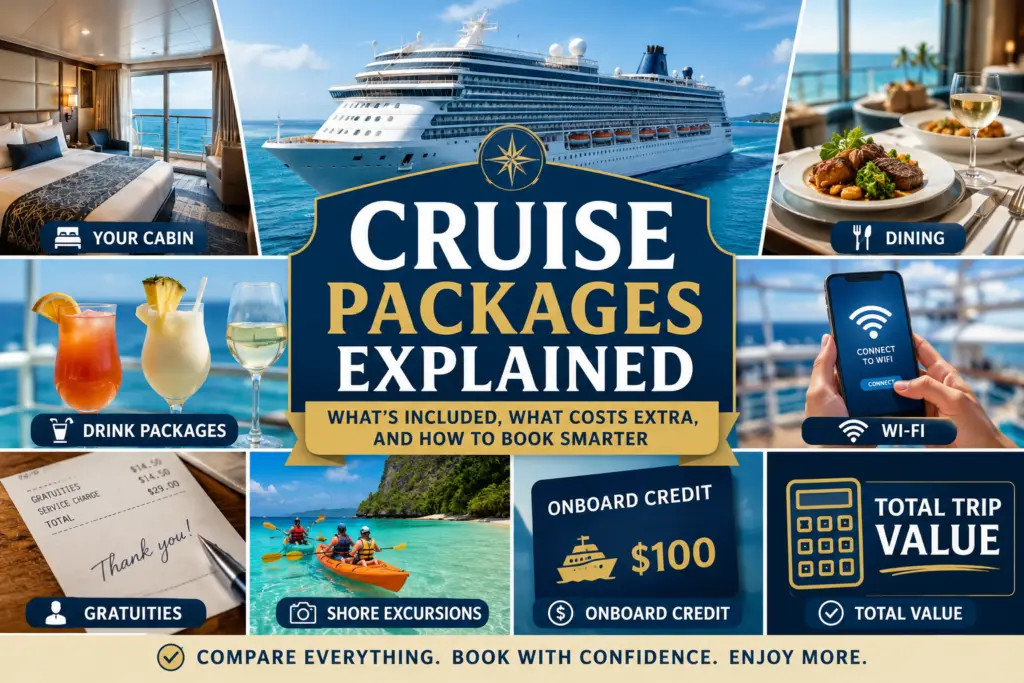
Cruise packages can look deceptively simple.
You see a cruise fare, a promotion, a few included perks, and a beautiful ship. Then you start comparing cabins, drink packages, Wi-Fi, gratuities, specialty dining, excursions, taxes, port expenses, flights, transfers, hotels, travel protection, and the actual cost of getting everyone from home to the ship and back again.
That is when the cheapest cruise on the first screen can stop being the cheapest vacation.
A cruise that costs more upfront may already include benefits you were planning to buy. Another sailing may advertise a much lower fare but become significantly more expensive after the extras are added. And sometimes the lower-cost package really is the better choice because you simply would not use the additional perks.
The goal is not to find the cruise package with the biggest advertised discount. It is to find the cruise package that gives you the best overall fit for the way you actually travel.
This Sehlmeyer Travel guide explains what cruise fares typically include, what often costs extra, how different pricing styles work, where package value can change by cruise line, and how to compare two offers before you commit your money.
[ez-toc]
Cruise Packages Explained: The Simple Version
A cruise package is more than the number shown beside a cabin.
It is the combination of your cruise fare, stateroom, itinerary, included dining and entertainment, required taxes and fees, promotional benefits, optional add-ons, and the logistics required to make the entire vacation work.
Most mainstream cruise fares include several basic parts of the trip:
- Your stateroom
- Many dining options
- Most standard entertainment
- Access to many public areas of the ship
- Transportation aboard the ship between the ports on your itinerary
Where things become more complicated is everything surrounding those basics.
Depending on the cruise line, fare type, promotion, and current terms, your package may also include or discount items such as beverages, Wi-Fi, specialty dining, gratuities, onboard credit, or other benefits.
Premium, luxury, expedition, and river cruise lines may include more in the upfront price. Mainstream cruise lines often give travelers a lower base fare and allow them to add the extras they value.
Neither approach is automatically better. You simply need to understand what you are paying for and what you are likely to spend after the initial fare.
What Is Usually Included in a Cruise Fare?
Every cruise line structures its fares differently, but these are the core vacation elements commonly included on mainstream cruises.
| Cruise Feature | Usually Included? | What to Compare |
|---|---|---|
| Stateroom | Yes | Interior, oceanview, balcony, suite, size, location, connecting cabins, obstruction, and category benefits can all affect value. |
| Main Dining | Usually | Specialty restaurants, premium menu items, and certain dining experiences may carry an additional charge. |
| Buffet & Casual Dining | Usually | The number, quality, variety, and hours of included venues vary significantly by ship. |
| Standard Entertainment | Usually | Most theater shows and everyday entertainment are included, although select activities or premium experiences may cost extra. |
| Pools & Public Spaces | Usually | Thermal suites, cabanas, reserved areas, or certain adult-only spaces may require an additional fee. |
| Kids’ Clubs | Often | Age rules, nursery care, late-night supervision, reservations, and capacity can vary. |
| Transportation Between Ports | Yes | The ship transports you between ports, but transportation and activities once you leave the ship are usually separate expenses. |
What Usually Costs Extra on a Cruise?
This is where total cruise cost begins to separate from the advertised fare.
You may use very few extras, or you may consider several of them essential. That is why there is no universal answer to whether a particular cruise package is “worth it.”
| Potential Extra | Why It Matters | What I Would Compare |
|---|---|---|
| Alcohol, Soda, Specialty Coffee & Bottled Water | Beverage spending can add up quickly over a seven-day cruise. | Compare package price against what you realistically expect to drink—not against the maximum theoretical value. |
| Wi-Fi | Internet may matter for work, family communication, social media, or staying connected at home. | Check devices, users, speeds, streaming capability, and whether the cruise-line app functions without a paid package. |
| Gratuities or Service Charges | Daily charges can become significant for families, groups, and longer sailings. | Determine whether gratuities are included, prepaid, or charged during the cruise. |
| Specialty Dining | Premium restaurants may be a major part of the experience for some travelers and irrelevant to others. | Compare how many specialty meals you would actually purchase. |
| Shore Excursions | Port days can become one of the biggest variables in the vacation budget. | Alaska, Europe, expedition-style trips, and bucket-list ports can require much larger excursion budgets than a simple beach day. |
| Spa, Casino, Arcade, Photos & Premium Activities | These are easy to ignore before sailing and easy to spend money on once onboard. | Build a realistic discretionary spending amount into your vacation budget. |
| Flights, Hotels, Transfers & Parking | A cruise fare tells you almost nothing about the cost of getting to the ship. | Compare the complete door-to-door trip, including an appropriate pre-cruise arrival plan. |
| Travel Protection | Cruises involve deposits, cancellation rules, final-payment deadlines, medical considerations, and travel disruptions. | Understand the protection options and terms before you need them. |
Why “All-Inclusive Cruise” Can Be Misleading
The term all-inclusive cruise is one of the easiest ways for travelers to misunderstand cruise pricing.
Most mainstream cruises are not all-inclusive in the same sense that travelers commonly use that phrase for an all-inclusive resort.
Your base cruise fare may cover the room, included dining, standard entertainment, and transportation between ports. Beverages, Wi-Fi, gratuities, specialty dining, shore excursions, spa services, photographs, and other extras may still be separate.
Some cruise lines offer upgraded fares or packages that bundle several of those costs. Premium, luxury, expedition, and river cruise brands may include considerably more in the initial price.
That does not automatically make a more-inclusive cruise a better deal, and it does not automatically make a lower base fare cheaper.
The question I would ask before comparing any two cruise packages:
What will this vacation realistically cost me after I add the things my travelers actually want?
Three Common Cruise Pricing Styles
Most cruise offers can be understood through three broad pricing models.
1. Base Fare Cruise Pricing
A base fare typically gives you the core cruise experience at the lowest starting price, then allows you to add optional items separately.
This approach can make excellent sense for travelers who:
- Drink very little
- Do not need much internet access
- Are satisfied with included dining
- Prefer to purchase extras individually
- Want tighter control over onboard spending
The potential problem is assuming the base fare represents the final vacation cost.
Once you add beverages, Wi-Fi, gratuities, excursions, specialty dining, and transportation to the cruise port, the financial picture can look very different.
2. Perk-Based or Bundled Cruise Packages
Some cruise lines offer fares or promotions that bundle additional benefits such as beverages, Wi-Fi, specialty dining, onboard credit, gratuities, or other perks.
The package can be a strong value when those inclusions match what you were already planning to buy.
The mistake is assigning full value to a perk simply because the cruise line says it is included.
If you would never have purchased a particular benefit, its advertised value should not be the reason you choose a more expensive fare.
3. More-Inclusive, Luxury, or River Cruise Pricing
Some premium, luxury, expedition, and river cruise lines build more of the vacation into the upfront price.
Depending on the line and current fare terms, that may include certain combinations of beverages, Wi-Fi, specialty dining, excursions, gratuities, transfers, or other benefits.
The initial price can be substantially higher, but travelers who value a smoother and more inclusive experience may find that the total trip value compares more favorably than the first number suggests.
How to Compare the Real Value of a Cruise Package
When I compare cruise options, I do not want to know only which sailing has the lowest advertised price.
I want to understand what the traveler is actually getting for the money.
Before deciding between two cruise packages, compare:
- Base cruise fare
- Taxes, fees, and port expenses
- Cabin category, size, and location
- Beverage package or beverage inclusions
- Wi-Fi access
- Gratuities or service charges
- Specialty dining benefits
- Onboard credit
- Shore excursions and likely port-day spending
- Flights and baggage costs
- Transfers, parking, rental cars, and hotels
- Travel protection
- Deposit terms
- Final-payment deadlines
- Cancellation rules
Then compare the experience itself.
If you do not drink alcohol, an expensive beverage package may contribute very little value. If you own a business and need dependable access to home or work, Wi-Fi may matter much more. If you are cruising with children, cabin layout and family-friendly spaces may outweigh a small difference in fare.
Good cruise value is personal.
That is why two travelers can look at the same package and reasonably reach different conclusions.
Ready for the Next Step?
Compare Real Cruises—Then Choose How Much Help You Want
If you understand the package differences and are ready to see actual sailings, you can start searching cruises yourself. If you would rather have Matt compare the ship, cabin, itinerary, package perks, flights, and total value with you, Sehlmeyer Travel can handle that side too.
Book online, ask for help when you need it, or have Matt handle the cruise planning from the beginning.
Cruise Package Value by Cruise Line
Different cruise lines build value in very different ways.
This is one reason comparing two cruises based only on price can be misleading. Two sailings may cost nearly the same but offer completely different ships, cabin experiences, package structures, dining styles, entertainment, and included benefits.
If you are still deciding between brands, the Sehlmeyer Travel Cruise Line Guide can help you compare the broader cruise experience before narrowing actual sailings.
Royal Caribbean
Royal Caribbean can be a strong fit for families, multigenerational groups, teens, couples, and active travelers who want large ships, significant onboard entertainment, private-island-style experiences, and plenty to do.
The ship itself often matters enormously with Royal Caribbean. A traveler choosing one of the line’s newest and largest ships may be purchasing a very different vacation experience than someone choosing an older or smaller ship.
When comparing Royal Caribbean packages, pay particular attention to the cabin, beverage costs, Wi-Fi, specialty dining, excursions, and how much value your travelers place on the ship’s activities.
Often strongest value when: the onboard attractions and entertainment are an important part of the vacation rather than simply transportation between ports.
Disney Cruise Line
Disney Cruise Line frequently carries a higher upfront price than many mainstream competitors, but the fare is purchasing a highly specific family experience.
Disney’s entertainment, characters, dining concepts, kids’ programming, service, and overall atmosphere are part of the value calculation.
The important question is not whether Disney costs more. It is whether your travelers value the experience enough to justify that difference.
Often strongest value when: Disney itself is a major reason for choosing the cruise.
Norwegian Cruise Line
Norwegian Cruise Line can appeal to travelers who value flexible dining, entertainment, a relaxed approach to scheduling, and package-style offers.
The value of a Norwegian fare can depend heavily on the specific promotion, ship, itinerary, cabin, and benefits attached to the booking.
This is a line where I would pay close attention to exactly what each advertised perk includes and what charges may still remain.
Often strongest value when: the included benefits closely match things you would have purchased anyway.
MSC Cruises
MSC Cruises can offer very competitive pricing and modern ships, particularly for travelers who are comfortable with its more international onboard style.
MSC is a good example of why I would never recommend choosing a cruise solely because the initial fare looks inexpensive.
Compare the ship, experience level, cabin, dining expectations, beverage options, Wi-Fi, private-island plans, and service style before deciding whether the value fits you.
Often strongest value when: you want a modern cruise experience at competitive pricing and understand exactly what is and is not included.
Princess Cruises
Princess Cruises often appeals to travelers interested in Alaska, Europe, Panama Canal itineraries, couples travel, and more destination-focused cruising.
Princess also commonly gives travelers different fare or package choices that can bundle additional vacation benefits depending on current terms.
The right comparison is not simply standard fare versus upgraded fare. Calculate what the additional benefits would cost you separately and whether you would actually use them.
Often strongest value when: itinerary and destination experience matter and the chosen package meaningfully reduces costs you were already expecting.
Celebrity Cruises
Celebrity Cruises often works well for adults and couples looking for a more refined mainstream experience with modern design, strong dining, and a less family-focused atmosphere than some large-ship competitors.
Celebrity can make sense for travelers who care about the overall onboard feel as much as the itinerary.
Often strongest value when: you want an elevated mainstream cruise experience without necessarily moving into full luxury-cruise pricing.
Holland America Line
Holland America Line often appeals to Alaska travelers, adults, couples, longer-itinerary cruisers, and travelers who prefer a calmer and more traditional ship experience.
The value is often found in itinerary, destination access, service, dining, music, enrichment, and pacing rather than massive onboard attractions.
Often strongest value when: destination and a more relaxed ship experience matter more than waterslides, amusement-style attractions, and constant activity.
Viking and River Cruise Lines
Viking and river cruise companies such as AmaWaterways represent a different value model from the typical large mainstream ocean cruise.
These trips often emphasize smaller ships, destination depth, cultural experiences, and a more structured or inclusive approach to the vacation.
The upfront price may be considerably higher than a mainstream ocean cruise, but comparing only the base fare misses the point because the products themselves are so different.
Often strongest value when: you prioritize destination immersion, a smaller-ship experience, and additional inclusions over the large-resort atmosphere of a mainstream ocean ship.
Are Drink Packages Worth It?
Drink packages can be worth the money, but they are not automatic savings.
The calculation depends on what you drink, how often you drink, the package price, the itinerary, package restrictions, and how much convenience matters to you.
Before purchasing a drink package, consider:
- Do you normally drink alcohol every day on vacation?
- Do you regularly order soda, specialty coffee, bottled water, mocktails, or energy drinks?
- How many sea days are on the itinerary?
- How many long port days will keep you away from the ship?
- Are gratuities already included in the package price?
- Does another traveler in the cabin also have to purchase a package?
- Are there beverage price caps or exclusions?
- Would paying as you go give you more flexibility?
If you drink very little, a beverage package may create unnecessary cost.
If vacation for you includes cocktails, wine, specialty coffee, bottled water, and the convenience of not thinking about individual charges, the package may provide both financial and practical value.
Is Cruise Wi-Fi Worth It?
Wi-Fi has become one of the most common cruise add-ons because travelers increasingly expect to remain connected.
That does not mean every traveler needs the same level of service.
Before buying internet access, compare:
- How many devices are covered
- Whether the package is priced by person or device
- Whether messaging and basic browsing are supported
- Whether video calls or streaming are supported
- Whether the cruise-line app works without purchasing full internet access
- Whether one traveler can manage with Wi-Fi while others remain disconnected
A business owner may consider dependable internet essential. Another traveler may consider being unreachable for a week one of the best parts of the cruise.
Neither is wrong. Put the money toward the experience you actually want.
Are Gratuities Included on a Cruise?
Gratuity policies vary by cruise line, fare type, promotion, and package.
Some cruises include or prepay certain gratuities. Others apply daily service charges during the sailing or allow travelers to prepay them before departure.
This deserves attention because the total can become meaningful for families, groups, suites, and longer cruises.
Before booking, confirm:
- The daily gratuity or service-charge amount
- Whether it is already included in your fare
- Whether it can be prepaid
- Whether beverage-package gratuities are separate
- Whether specialty dining charges include gratuity
- Whether suite or premium cabin categories have different service charges
Are Shore Excursions Included?
On most mainstream ocean cruises, shore excursions are purchased separately.
Travelers may book through the cruise line, use independent tour operators, or explore certain ports on their own.
Excursion spending is one of the largest variables in the total cost of a cruise.
A Caribbean port might be perfect for an inexpensive beach day. An Alaska itinerary may tempt you with wildlife tours, glacier experiences, rail journeys, or helicopter excursions. Europe can involve guided historical tours, transportation between the port and major cities, and long sightseeing days.
That is why I recommend thinking about the ports before choosing a cruise rather than treating excursions as an afterthought.
Family Cruise Package Tips
Families need to look beyond the advertised fare because nearly every major cost is multiplied by the number of travelers.
Compare:
- Flights for the entire family
- Pre-cruise hotel rooms
- Transfers, parking, or rental cars
- Connecting cabins or larger family accommodations
- Kids’ and teen programming
- Soda or beverage packages
- Wi-Fi
- Excursions
- Gratuities
- Travel protection
Also pay close attention to cabin layout. A lower-priced cabin that creates a miserable sleeping arrangement for four people is not necessarily better value than spending more for a setup that allows the family to function comfortably for a week.
If you are comparing brands, start with the Best Family Cruises Guide.
Couples Cruise Package Tips
Couples often evaluate cruise value differently from families.
Dining quality, balcony cabins, adult spaces, spa access, nightlife, itinerary style, beverages, and the overall atmosphere of the ship may become more important.
A couple celebrating an anniversary or honeymoon may decide that a balcony, specialty dining, upgraded package, or more refined cruise line adds meaningful value to the trip.
Another couple may prefer a lower base fare and put the savings toward excursions or another vacation.
The right package should support the reason you are taking the trip.
Solo Traveler Cruise Package Tips
Solo travelers should pay close attention to pricing because many cruise fares are structured around double occupancy.
Compare:
- Solo or studio cabin availability
- Single supplements
- Solo traveler promotions
- Studio or solo lounges
- Dining comfort
- Onboard social opportunities
- Package benefits that may be calculated differently for one traveler
A cruise package that looks excellent for a couple may work very differently for one person.
Helpful resource: Best Cruise Lines for Solo Travelers.
Group Cruise Package Tips
Group cruise value goes beyond the cost of one cabin.
A successful group sailing must accommodate people who may have different budgets, cabin preferences, dining expectations, flight needs, activity levels, and vacation priorities.
Consider:
- Cabin inventory
- Different cabin categories and price points
- Deposit requirements
- Payment deadlines
- Departure-port convenience
- Dining arrangements
- Flights for travelers coming from different cities
- Drink and Wi-Fi preferences
- Excursion participation
- How much time the group actually wants to spend together
The best group cruise is rarely the cruise with the absolute lowest cabin price. It is the one that gives enough people the right combination of value, flexibility, activities, and logistics to make the group work.
First-Time Cruiser Package Tips
Your first cruise should feel understandable before you book it.
Do not let a dramatic promotion push you into a fare you do not understand.
Before booking your first cruise, know:
- What your cruise fare includes
- Which expenses may be charged onboard
- How dining works
- How gratuities are handled
- Whether beverages and Wi-Fi are included
- How excursions work
- What documents you need
- When your final payment is due
- What the cancellation rules are
If you are still deciding whether the cruise experience fits you, read Why Take a Cruise?.
When Is the Best Time to Book a Cruise Package?
There is no single perfect booking date for every cruise.
The right timing depends on the destination, ship, dates, cabin requirements, airfare, flexibility, and popularity of the sailing.
Earlier planning becomes particularly useful when you need:
- Connecting cabins
- Family accommodations
- Suites
- Accessible cabins
- Specific cabin locations
- School-break dates
- Holiday sailings
- Alaska cruises
- Europe cruises
- Popular new ships
Last-minute cruise deals can exist, but they usually reward flexibility.
If you need specific dates, a particular ship, a certain cabin arrangement, nonstop flights, or a high-demand itinerary, waiting for a possible last-minute discount can create more problems than savings.
Why Wave Season Gets So Much Attention
Wave season generally refers to the early-year period when cruise companies heavily promote bookings with offers that may include reduced deposits, onboard credit, package incentives, fare promotions, or other benefits.
It can be a useful time to shop for a cruise.
It is not a reason to abandon normal decision-making.
A promotion is valuable only when:
- The cruise line fits your travelers
- The ship fits your travel style
- The itinerary fits your goals
- The cabin fits your needs
- The package benefits have real value to you
- The complete vacation cost fits your budget
A promotion should improve the right cruise. It should not convince you to book the wrong one.
Cruise Package Red Flags
A promotion is not automatically suspicious simply because it is aggressive. Cruise pricing is promotional by nature.
But some details deserve a closer look before you commit.
- A very low fare without a clear understanding of taxes and fees
- “Included” benefits whose restrictions are difficult to understand
- Drink packages that do not cover the beverages you expect
- Wi-Fi packages that cover fewer people or devices than you assumed
- Large onboard-credit offers distracting from a higher overall cost
- Guarantee cabins when location is important to you
- Nonrefundable deposits when your plans are uncertain
- A cheap cruise requiring unusually expensive flights
- An excursion-heavy itinerary with no realistic port budget
- A package containing multiple perks you would never have purchased separately
The danger is not the promotion itself.
The danger is booking the promotion before understanding the vacation attached to it.
How to Compare Two Cruise Offers
If you are down to two cruise packages, use the same process I would use before choosing between them.
Step 1: Make the Comparison Fair
Start with reasonably similar products.
Compare sailing length, cabin category, itinerary, travel dates, departure port, and ship experience.
A seven-night balcony cabin should not automatically be compared with a four-night interior cabin simply because both fall under the word “cruise.”
Step 2: Add the Required Costs
Calculate the costs that are difficult to avoid:
- Taxes and port expenses
- Gratuities
- Flights
- Baggage
- Pre-cruise hotels
- Transfers
- Parking
- Travel protection
Step 3: Add the Extras You Will Actually Use
Now add realistic spending for:
- Beverages
- Wi-Fi
- Specialty dining
- Shore excursions
- Spa treatments
- Photographs
- Arcade or premium activities
- Other onboard spending you reasonably expect
Do not add every possible expense. Add your expenses.
Step 4: Compare the Experience
This is where simple spreadsheets stop being enough.
Compare:
- Ship size and atmosphere
- Cabin comfort and location
- Dining
- Entertainment
- Activities
- Port times
- Private-island or beach days
- Kids’ and teen facilities
- Adult spaces
- Overall cruise-line fit
Step 5: Decide Based on Total Value
Now you can finally ask the question that matters:
Which option gives these travelers the better vacation for the total amount of money being spent?
Sometimes that will be the cheaper cruise.
Sometimes spending a little more upfront avoids hundreds of dollars in extras.
Sometimes a more expensive ship, cabin, itinerary, or package simply produces a vacation that fits your travelers much better.
That is cruise value.
Helpful Cruise Planning Resources
If you are still narrowing the cruise line, itinerary, destination, or travel style, these Sehlmeyer Travel guides can help you continue the research:
- Cruise Line Guide: Compare Cruise Lines by Travel Style
- Cruise Travel Guides
- Best Family Cruises
- Expedition Cruise Guide: Antarctica, Arctic, Galápagos, Alaska, and Remote Destinations
- Why Take a Cruise?
- Best Cruise Lines for Solo Travelers
- Best Caribbean Cruise Ports
- Alaskan Cruise Guide
- Ultimate Caribbean Travel Guide
- Travel Guide Library
Cruise Packages FAQ
Are cruises really all-inclusive?
Most mainstream cruises are not fully all-inclusive. Your fare commonly includes your stateroom, many dining venues, standard entertainment, and transportation between ports. Beverages, Wi-Fi, gratuities, specialty dining, shore excursions, spa services, photographs, and other extras may cost more.
What is usually included in a cruise package?
A standard cruise package generally includes your cabin, many meals, standard entertainment, access to public spaces, and transportation aboard the ship between ports. Depending on the fare, promotion, and cruise line, additional items such as beverages, Wi-Fi, dining, onboard credit, or gratuities may also be included.
What commonly costs extra on a cruise?
Common additional expenses include alcoholic beverages, soda, specialty coffee, bottled water, Wi-Fi, gratuities, specialty restaurants, shore excursions, spa services, photos, casino spending, arcade games, premium activities, travel protection, flights, transfers, parking, and pre-cruise hotels.
Are cruise drink packages worth it?
They can be. The value depends on what you drink, how much you drink, the number of sea and port days, package restrictions, gratuities, and the package price. Travelers who consume very few paid beverages may be better off paying individually, while others may value both the savings and convenience of a package.
Is Wi-Fi included on cruises?
That varies by cruise line, ship, fare, package, and promotion. Some offers include internet access while others require travelers to purchase it separately. Device limits and service levels can also vary.
Are gratuities included in cruise packages?
Sometimes. Certain fares or packages may include or prepay gratuities, while other cruises apply daily service charges separately. Confirm the current policy before booking so the charge is part of your expected vacation budget.
Are shore excursions included on cruises?
On most mainstream ocean cruises, shore excursions are purchased separately. Travelers may book through the cruise line, use independent operators, or explore some ports independently.
When is the best time to book a cruise package?
The best timing depends on your ship, destination, cabin needs, travel dates, and flexibility. Earlier booking can be particularly valuable for connecting cabins, family rooms, suites, school breaks, holidays, Alaska, Europe, popular new ships, and travelers who need a specific cabin location.
What should I compare before booking a cruise package?
Compare the cruise line, ship, cabin, itinerary, taxes and fees, beverages, Wi-Fi, gratuities, specialty dining, onboard credit, shore excursions, flights, hotels, transfers, travel protection, deposit terms, final-payment deadlines, and complete vacation cost.
Can I search cruises myself and still work with Sehlmeyer Travel?
Yes. Travelers can begin by researching available cruises online and still use Sehlmeyer Travel when they want help comparing ships, cabins, itineraries, packages, flights, logistics, or total value. Travelers who prefer full-service planning can also have Matt handle the cruise-planning process from the beginning.
What makes one cruise package a better value than another?
The better value is the package that gives your travelers the strongest combination of price, inclusions, cabin, itinerary, ship experience, logistics, and benefits they will actually use. The lowest starting fare and the package with the most advertised perks are not automatically the best choice.