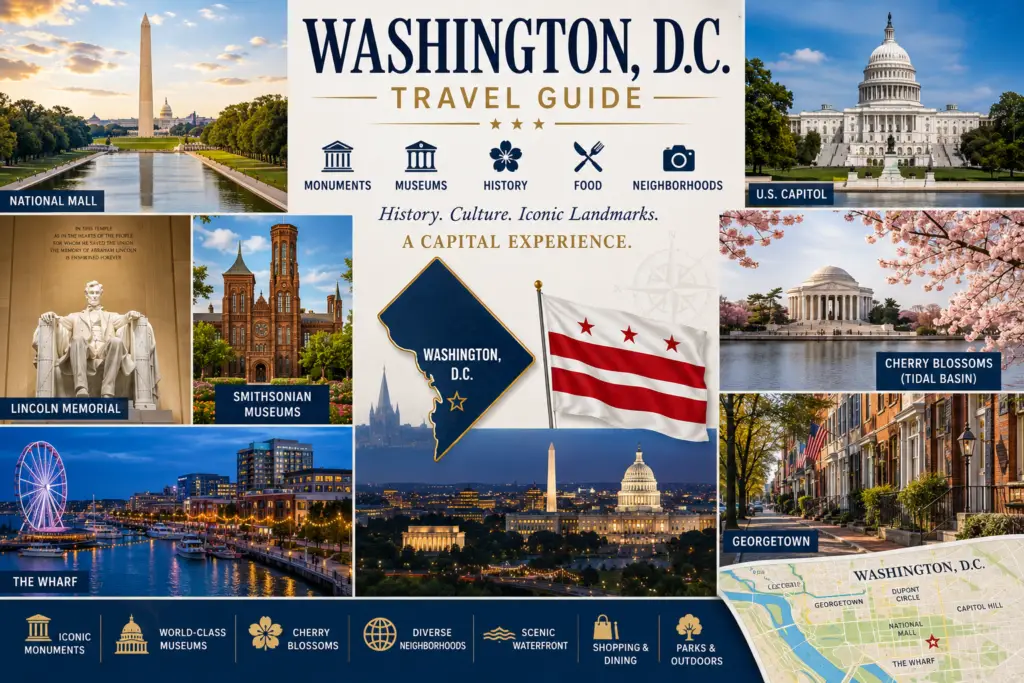
Washington, D.C. is one of the best city destinations in the United States for travelers who want monuments, museums, history, government buildings, walkable neighborhoods, food, culture, riverfront areas, and meaningful family travel.
This guide is for Washington, D.C., the nation’s capital. It is separate from the Washington State Travel Guide, which covers Seattle, Mount Rainier, Olympic National Park, the San Juan Islands, Spokane, wine country, and Pacific Northwest scenery.
The key is choosing the right version of Washington, D.C. for your trip. A family museum trip feels very different from a couples weekend in Georgetown, a school-style history itinerary, a cherry blossom getaway, or a food and neighborhood-focused city escape.
This Washington, D.C. travel guide will help you compare the best places to visit, who D.C. is best for, how to plan your time, when to go, where to stay, and how to avoid the most common planning mistakes.
Why Visit Washington, D.C.?
Washington, D.C. works well for families, couples, history travelers, museum lovers, food travelers, school groups, first-time city travelers, and anyone who wants a trip that feels both educational and memorable.
The National Mall is the main anchor for most first-time visitors. It connects many of the city’s biggest landmarks, including the Lincoln Memorial, Washington Monument, World War II Memorial, Vietnam Veterans Memorial, Korean War Veterans Memorial, Martin Luther King Jr. Memorial, U.S. Capitol area, and several Smithsonian Museums.
Beyond the monuments, Washington, D.C. also offers strong neighborhoods, restaurants, markets, riverfront districts, sports, theater, parks, embassies, historic homes, and easy add-ons into nearby Virginia and Maryland.
For travelers from Defiance, Northwest Ohio, and the Midwest, Washington, D.C. can work well as a long weekend, school-break family trip, history-focused vacation, East Coast road trip stop, or larger route with Virginia, Maryland, Pennsylvania, or New York.
Washington, D.C. vs. Washington State
This is worth clearing up because the names can confuse travelers and search engines.
Washington, D.C. is the nation’s capital. It is best for monuments, museums, government buildings, American history, Georgetown, The Wharf, cherry blossoms, the National Mall, and city-based sightseeing.
Washington State is in the Pacific Northwest. It is best for Seattle, Mount Rainier, Olympic National Park, islands, mountains, forests, wine regions, and outdoor scenery. You can read that separate guide here: Washington State Travel Guide.
If you want museums and monuments, choose Washington, D.C. If you want mountains, national parks, Seattle, and Pacific Northwest scenery, choose Washington State.
Who Washington, D.C. Is Best For
Washington, D.C. can fit several travel styles, but the itinerary should match the traveler. A family with kids will usually plan differently than a couple, history lover, museum fan, or traveler who wants food and neighborhoods.
| Traveler Type | Is Washington, D.C. a Good Fit? | Why |
|---|---|---|
| Families | Yes | Free museums, monuments, parks, history, the National Zoo, walkable areas, and educational attractions make D.C. excellent for families. |
| Couples | Yes | Georgetown, The Wharf, museums, fine dining, rooftop views, theater, historic hotels, and cherry blossom season can create a great couples trip. |
| History Travelers | Yes | The National Mall, memorials, Capitol Hill, National Archives, Arlington National Cemetery, and historic neighborhoods make D.C. one of the strongest history trips in the country. |
| Museum Lovers | Yes | The Smithsonian Museums, National Gallery of Art, Holocaust Memorial Museum, International Spy Museum, and other major museums give the city serious depth. |
| Food and Neighborhood Travelers | Yes | Georgetown, The Wharf, Dupont Circle, Capitol Hill, Union Market, Adams Morgan, and Shaw offer restaurants, markets, nightlife, and local character. |
| Travelers Wanting Beaches or Theme Parks | No | D.C. is better for history, museums, monuments, neighborhoods, and culture. For beaches and major theme parks, compare Florida or California. |
Best Places to Visit in Washington, D.C.
Washington, D.C. is compact compared with many major cities, but the best sights still require planning. The National Mall is walkable, but it is much larger than many first-time visitors expect.
National Mall
The National Mall is the heart of most Washington, D.C. trips. It connects many of the city’s biggest monuments, memorials, museums, and government buildings.
Travelers often visit the Lincoln Memorial, Washington Monument, World War II Memorial, Vietnam Veterans Memorial, Korean War Veterans Memorial, Martin Luther King Jr. Memorial, Jefferson Memorial, U.S. Capitol area, and Smithsonian Museums.
The biggest mistake is underestimating the walking. The National Mall looks simple on a map, but families and first-time visitors should plan comfortable shoes, water, breaks, and realistic pacing.
Washington Monument
The Washington Monument is one of the most recognizable landmarks in the United States. It anchors the skyline and gives the National Mall its classic view, especially around sunrise and sunset.
The area around the monument is useful for photos, walking routes, and connecting nearby memorials. If visiting the monument interior matters to your trip, plan ahead because access and ticket availability can vary.
Lincoln Memorial
The Lincoln Memorial is one of the most powerful stops in Washington, D.C. It is especially memorable in the early morning, at sunset, or after dark when the memorial and Reflecting Pool feel quieter and more dramatic.
This is a must-see for first-time visitors, families, history travelers, photographers, and anyone who wants one of the city’s most iconic views.
U.S. Capitol
The U.S. Capitol is one of the most important government buildings in the country and a major stop for travelers interested in history, architecture, and American government.
Visitors can view the exterior from the Capitol grounds and may be able to plan a tour depending on current access and availability. The area also connects well with the Library of Congress, Supreme Court, and Capitol Hill.
White House
The White House is one of the most famous sights in Washington, D.C. Many travelers view it from Lafayette Square or nearby public viewing areas.
White House tours require advance planning through a congressional office and are not something to leave until the last minute. Even without a tour, seeing the exterior is a meaningful stop for many first-time visitors.
Smithsonian Museums
The Smithsonian Museums are one of the biggest reasons to visit Washington, D.C. Many of the most popular museums are located near the National Mall and are free to enter, which makes the city especially valuable for families and museum lovers.
Popular choices include the National Museum of American History, National Air and Space Museum, National Museum of Natural History, National Museum of African American History and Culture, National Museum of the American Indian, Hirshhorn Museum, and Smithsonian Castle area.
Do not try to visit too many museums in one day. Pick one or two priorities, then leave time for meals, walking, monuments, and rest. Also check whether a specific museum requires timed entry before you go.
National Museum of African American History and Culture
The National Museum of African American History and Culture is one of the most important museum experiences in Washington, D.C. It is powerful, emotional, thoughtfully designed, and worth planning around.
This museum can be especially meaningful for adults, families with older kids, history travelers, and visitors who want a deeper understanding of American history. Timed-entry passes are commonly part of the planning process, so check availability early.
National Archives
The National Archives is an important stop for travelers who want to see some of the country’s founding documents and connect the trip to American history in a direct way.
It pairs well with the National Mall, Smithsonian Museums, U.S. Capitol area, and history-focused itineraries.
Arlington National Cemetery
Arlington National Cemetery is located across the Potomac River in Virginia, but it is a common and meaningful add-on to a Washington, D.C. trip.
Travelers often visit the Tomb of the Unknown Soldier, Changing of the Guard, John F. Kennedy gravesite, and memorial areas. This stop should be planned with respect, time, and realistic walking expectations.
Tidal Basin
The Tidal Basin is one of the most scenic areas in Washington, D.C., especially during cherry blossom season. It also connects visitors with the Jefferson Memorial, Martin Luther King Jr. Memorial, and Franklin Delano Roosevelt Memorial.
Cherry blossom season is beautiful, but it is also one of the busiest times to visit. If blossoms are a priority, book early, expect crowds, and be flexible because peak bloom timing changes by year.
Georgetown
Georgetown gives Washington, D.C. a more historic neighborhood feel. Travelers visit for cobblestone streets, shopping, restaurants, waterfront views, historic homes, boutique hotels, and the C&O Canal area.
Georgetown works well for couples, food travelers, shoppers, college visitors, and anyone who wants a break from monuments and museums.
The Wharf
The Wharf is one of D.C.’s best modern waterfront areas. It offers restaurants, music venues, hotels, rooftop views, seafood, walking paths, and a lively evening atmosphere along the Southwest Waterfront.
This is a strong option for couples, adults, friend trips, and families looking for dinner or waterfront time after a museum day.
Dupont Circle
Dupont Circle is known for embassies, historic homes, bookstores, restaurants, cafes, galleries, and a local neighborhood feel. It can be a good base for travelers who want something more residential than the National Mall area.
Dupont works well for couples, repeat visitors, food travelers, and people who enjoy walkable neighborhoods.
Eastern Market and Capitol Hill
Eastern Market and Capitol Hill offer a neighborhood-focused side of Washington, D.C. Travelers can explore market stalls, local food, row houses, shops, and a more community-centered atmosphere.
This area pairs well with the U.S. Capitol, Library of Congress, Supreme Court, and Capitol Hill sightseeing.
National Zoo
The Smithsonian National Zoo can be a great family-friendly addition to a Washington, D.C. trip. It gives kids a break from monuments and museums while still fitting the city’s educational travel style.
Families should plan around walking, weather, animal activity, and transportation because the zoo is not directly on the National Mall.
Washington, D.C. Destination Comparison
Here is a simple way to compare some of the most popular Washington, D.C. areas and attractions.
| D.C. Area or Attraction | Best For | Trip Style |
|---|---|---|
| National Mall | Monuments, memorials, museums, first-time visitors | Historic, walkable, iconic |
| Smithsonian Museums | Families, museum lovers, rainy days, budget-friendly trips | Educational, flexible, high-value |
| Georgetown | Couples, shopping, dining, waterfront, historic streets | Charming, upscale, slower-paced |
| The Wharf | Dining, music, waterfront hotels, evening plans | Modern, lively, scenic |
| Capitol Hill | Government buildings, Eastern Market, history, walking | Historic, local, civic |
| Dupont Circle | Restaurants, embassies, cafes, bookshops, repeat visitors | Neighborhood-focused, walkable, cultured |
| Arlington National Cemetery | History, reflection, military heritage, meaningful add-ons | Respectful, emotional, historic |
Best Washington, D.C. Trips for Families
Washington, D.C. is one of the best family city trips in the country because so many major attractions are educational, memorable, and budget-friendly.
Families can build a trip around the Smithsonian Museums, National Mall, monuments, National Zoo, National Archives, Capitol area, riverfront walks, and guided tours. The city is especially strong for kids who are learning about American history, government, space, science, animals, or culture.
The best family D.C. trips do not try to do every museum. Pick a few must-see experiences, leave room for breaks, and remember that the National Mall involves a lot of walking.
Travel Advisor Tip: Washington, D.C. family trips work best when you alternate heavy history days with lighter experiences. Mix monuments and museums with parks, food stops, Georgetown, The Wharf, the National Zoo, or a Potomac River activity.
If you are comparing Washington, D.C. with other family vacation ideas, these guides can help: Family Vacation Planning Checklist or Best Family Cruises.
Best Washington, D.C. Trips for Couples
Washington, D.C. can be an excellent couples destination because it offers history, walkable neighborhoods, boutique hotels, restaurants, museums, waterfront areas, theater, rooftop views, and seasonal beauty.
A couples trip might include a Georgetown dinner, a walk through the National Mall at sunset, museums during the day, cocktails or dinner at The Wharf, a show at the Kennedy Center, and a slower morning in Dupont Circle or Capitol Hill.
Cherry blossom season can be especially romantic, but it is also crowded. Couples who want a calmer trip may prefer fall, early winter, or a non-holiday spring weekend.
Best Washington, D.C. Trips for Mature Travelers
Washington, D.C. can work very well for mature travelers, but pacing matters. The city is rewarding, but it can involve long walks, security lines, stairs, uneven surfaces, summer heat, and museum fatigue if the schedule is too aggressive.
For a smoother trip, choose a hotel near your main priorities, group activities by area, use the Metro or rideshare when walking distances get long, and avoid trying to cover the entire National Mall in one push.
Good mature-traveler options can include a guided monument tour, a Smithsonian-focused day, Georgetown or Dupont Circle dining, Arlington National Cemetery, the National Archives, and a slower museum day with time for lunch and rest.
Best Washington, D.C. Museum and History Experiences
Washington, D.C. is one of the strongest museum and history destinations in the country. The best approach is to choose experiences by interest instead of trying to see everything.
Best for American History
The National Museum of American History, National Archives, U.S. Capitol area, Lincoln Memorial, and major memorials are strong choices for travelers focused on American history.
Best for Science and Space
The National Air and Space Museum, National Museum of Natural History, and nearby science-focused exhibits are excellent for families and curious travelers.
Best for Art
The National Gallery of Art, Hirshhorn Museum, Smithsonian American Art Museum, and National Portrait Gallery are strong choices for art-focused visitors.
Best for Deeper Reflection
The National Museum of African American History and Culture, Holocaust Memorial Museum, Vietnam Veterans Memorial, Korean War Veterans Memorial, and Arlington National Cemetery offer meaningful, reflective experiences.
Best for Families
The Air and Space Museum, Natural History Museum, American History Museum, National Zoo, International Spy Museum, and National Mall monuments can all work well for families depending on ages and attention spans.
Best Washington, D.C. Neighborhoods to Visit
Washington, D.C. becomes a better trip when you explore beyond the National Mall. Neighborhoods add food, shops, local character, and a break from monument-heavy sightseeing.
Georgetown
Georgetown is best for historic streets, shopping, waterfront dining, upscale hotels, college atmosphere, and couples getaways.
The Wharf
The Wharf is best for waterfront restaurants, music venues, rooftop views, seafood, evening plans, and a more modern D.C. feel.
Capitol Hill
Capitol Hill is best for government buildings, Eastern Market, historic row houses, walking, and a more neighborhood-based D.C. experience.
Dupont Circle
Dupont Circle is best for embassies, restaurants, cafes, bookstores, historic homes, and travelers who want a walkable neighborhood base.
Adams Morgan
Adams Morgan is best for nightlife, restaurants, global food, murals, and a more energetic local neighborhood feel.
Shaw and U Street
Shaw and U Street are strong for food, music history, nightlife, restaurants, and a deeper look at D.C. culture beyond the monuments.
Best Washington, D.C. Itinerary Ideas
Washington, D.C. works well for short trips, but the itinerary should not be overloaded. The city rewards planning and pacing.
First-Time D.C. Weekend
This route can include the National Mall, Lincoln Memorial, Washington Monument, Smithsonian Museums, U.S. Capitol area, Georgetown, and one memorable dinner.
Family Museum Trip
This route can include the Air and Space Museum, Natural History Museum, American History Museum, National Zoo, monuments, and a lighter neighborhood evening.
History-Focused Trip
This route can include the National Archives, U.S. Capitol, Library of Congress, Lincoln Memorial, Martin Luther King Jr. Memorial, Arlington National Cemetery, and a guided tour.
Couples D.C. Getaway
This route can include Georgetown, The Wharf, museum time, rooftop views, a special dinner, Kennedy Center, and a sunset walk near the National Mall.
Cherry Blossom Trip
This route focuses on the Tidal Basin, Jefferson Memorial, Martin Luther King Jr. Memorial, early morning walks, photography, and neighborhood dining.
D.C., Virginia, and Maryland Add-On
This route can include Washington, D.C. plus nearby Virginia and Maryland stops such as Arlington, Alexandria, Mount Vernon, National Harbor, Annapolis, or waterfront areas depending on the trip length.
Best Time to Visit Washington, D.C.
Washington, D.C. can be visited year-round, but spring and fall are usually the most comfortable seasons for walking, sightseeing, monuments, museums, and neighborhoods.
Spring is famous for cherry blossoms, but it can be crowded and expensive. Summer works for families and school breaks, but heat and humidity matter. Fall is one of the best overall times for weather, walking, and fewer peak blossom crowds. Winter can be good for museums, holiday lights, lower crowds, and value-minded travelers.
| Season | What to Expect | Best For |
|---|---|---|
| Spring | Cherry blossoms, comfortable weather, high demand, school trips, and busy monument areas. | Cherry blossoms, couples, families, photographers, and first-time visitors. |
| Summer | Hot and humid weather, family travel, school breaks, museum-heavy days, and busy attractions. | Families, museum trips, travelers tied to school schedules, and flexible planners. |
| Fall | Comfortable temperatures, strong walking weather, fewer blossom-season crowds, and beautiful city parks. | Couples, families, first-time visitors, history trips, and neighborhood-focused travel. |
| Winter | Cold weather, lower crowds, indoor museum value, holiday lights, and easier hotel availability in some periods. | Museums, history trips, budget-conscious travelers, couples, and flexible travelers. |
Suggested Washington, D.C. Trip Lengths
Washington, D.C. can work as a long weekend, but a little extra time makes the trip much easier.
- 2 to 3 nights: Good for a quick first visit, couples weekend, or focused museum-and-monument trip.
- 4 to 5 nights: Better for families, first-time visitors, Smithsonian Museums, National Mall, neighborhoods, and Arlington National Cemetery.
- 6 to 7 nights: Strong for a deeper D.C. trip with Georgetown, The Wharf, Capitol Hill, tours, museums, and nearby Virginia or Maryland add-ons.
- 8 to 10 nights: Best for a larger East Coast route that includes Washington, D.C., Virginia, Maryland, Pennsylvania, or New York.
Washington, D.C. Travel Planning Tips
Stay Near Your Main Priorities
D.C. hotel location matters. Penn Quarter, Downtown, Capitol Hill, Dupont Circle, Georgetown, The Wharf, and the National Mall area all feel different. Choose based on your itinerary, walking comfort, Metro access, and evening plans.
Do Not Overload Museum Days
The Smithsonian Museums are excellent, but museum fatigue is real. Pick one or two major museums per day and leave time for meals, monuments, and rest.
Use the Metro and Walk Strategically
Washington, D.C. is walkable, but the distances can surprise people. Use the Metro, rideshare, taxis, and smart route planning to avoid wasting energy.
Plan Popular Tours Early
Capitol tours, White House tours, timed-entry museums, popular restaurants, cherry blossom trips, and special exhibits may require planning ahead. Do not assume everything can be booked last minute.
Visit Monuments Early or Late
The monuments can be especially beautiful early in the morning or after dark. These times can also feel less crowded and more memorable than the middle of the day.
Build in Food and Neighborhood Time
The best D.C. trips are not only monuments and museums. Add Georgetown, The Wharf, Dupont Circle, Capitol Hill, Union Market, Adams Morgan, or Shaw to make the trip feel more complete.
Check Timed Entry Before You Go
Many D.C. attractions are easy to visit, but some museums, tours, and special experiences require timed entry or advance planning. This is especially important for high-demand museums, White House tours, Capitol tours, and cherry blossom season.
Common Washington, D.C. Vacation Mistakes to Avoid
- Confusing Washington, D.C. with Washington State when researching or booking.
- Trying to visit too many Smithsonian Museums in one day.
- Underestimating how much walking the National Mall requires.
- Waiting too long to plan White House, Capitol, or timed-entry museum visits.
- Choosing a hotel only by price instead of location and Metro access.
- Visiting cherry blossom season without expecting crowds and higher demand.
- Planning heavy museum days for kids without parks, food stops, or lighter breaks.
- Renting a car for a D.C.-only trip when walking, Metro, rideshare, taxis, and tours are usually easier.
Washington, D.C. vs. Other USA Vacation Destinations
Washington, D.C. is usually the best choice if you want monuments, museums, American history, government buildings, walkable neighborhoods, free attractions, and a meaningful family or couples city trip.
If you want iconic big-city energy, Broadway, skyscrapers, and major museums, compare New York. If you want Chicago architecture, Lake Michigan, museums, sports, and food, compare Illinois. If you want beaches, theme parks, and cruise ports, compare Florida. If you want Southern city charm, food, and coastal islands, compare Georgia or South Carolina.
If you want beaches, Outer Banks, Asheville, and Blue Ridge scenery, compare North Carolina. If you want nearby history, mountains, beaches, and colonial towns, compare Virginia or Maryland. If you want Pacific Northwest mountains, Seattle, national parks, islands, and outdoor scenery, compare Washington State.
For broader domestic travel planning, visit The USA Destination Page, browse the USA Travel Guides, or use the Travel Guide Library.
Need Help Planning a Washington, D.C. Vacation?
Washington, D.C. has incredible options, but the best trip depends on matching the right hotel area, museums, tours, walking pace, neighborhood plans, travel dates, and group needs.
Sehlmeyer Travel can help you compare Washington, D.C. vacation options and narrow down the trip that fits your family, budget, travel style, and comfort level.
Have a quick question first? Contact Sehlmeyer Travel.
Explore More USA and Travel Planning Guides
If you are comparing Washington, D.C. with other vacation options, these resources can help:
- The USA Destination Page
- USA Travel Guides
- Travel Guide Library
- Ultimate Travel Planning Guide
- How to Choose the Right Vacation Type
- Travel Advisor vs Booking Online
- Washington State Travel Guide
- New York Travel Guide
- Massachusetts Travel Guide
- Pennsylvania Travel Guide
- Virginia Travel Guide
- Maryland Travel Guide
Final Thoughts on Visiting Washington, D.C.
Washington, D.C. is one of the strongest U.S. city destinations for travelers who want history, museums, monuments, culture, food, neighborhoods, and meaningful sightseeing.
It can be a family museum trip, couples weekend, school-style history itinerary, cherry blossom getaway, government and monument tour, food-focused city escape, or a larger East Coast trip with nearby Virginia and Maryland.
The main thing is to plan the trip like a real city vacation, not just a checklist of monuments. Choose the right hotel area, pace the museums, group sightseeing by location, and leave room for neighborhoods, meals, and slower moments.
If your ideal trip includes the National Mall, Smithsonian Museums, Washington Monument, Lincoln Memorial, Capitol Hill, Georgetown, The Wharf, cherry blossoms, and American history, Washington, D.C. should be high on your list.
Frequently Asked Questions About Washington, D.C. Travel
What is Washington, D.C. best known for?
Washington, D.C. is best known for the National Mall, Smithsonian Museums, Washington Monument, Lincoln Memorial, U.S. Capitol, White House, Tidal Basin, cherry blossoms, Georgetown, The Wharf, and American history.
Is Washington, D.C. the same as Washington State?
No. Washington, D.C. is the nation’s capital on the East Coast and is best for monuments, museums, government buildings, and American history. Washington State is in the Pacific Northwest and is best for Seattle, Mount Rainier, Olympic National Park, islands, mountains, and outdoor scenery.
Is Washington, D.C. good for families?
Yes. Washington, D.C. is one of the best family city trips in the United States because of its museums, monuments, free attractions, history, parks, National Zoo, and educational value.
Is Washington, D.C. good for couples?
Yes. Washington, D.C. can be excellent for couples. Georgetown, The Wharf, museums, restaurants, rooftop views, theater, cherry blossoms, historic hotels, and evening monument walks can all create a strong couples getaway.
How many days do you need in Washington, D.C.?
Three to four days is a good starting point for a first Washington, D.C. trip. That gives time for the National Mall, several museums, key monuments, Georgetown or The Wharf, and one slower neighborhood or tour day.
What is the best time to visit Washington, D.C.?
Spring and fall are usually the best times to visit Washington, D.C. because the weather is more comfortable for walking. Spring is famous for cherry blossoms, while fall is often easier for sightseeing with fewer peak-season blossom crowds.
Do you need a rental car in Washington, D.C.?
No, most Washington, D.C. trips do not need a rental car. Walking, Metro, rideshare, taxis, and tours are usually easier than dealing with parking. A car may help only if you are adding wider regional stops in Virginia or Maryland.
Are Smithsonian Museums free?
Many Smithsonian Museums in Washington, D.C. are free to enter, which makes the city especially valuable for families and museum-focused travelers. Some museums or special experiences may require timed entry or advance planning.
Where should first-time visitors stay in Washington, D.C.?
First-time visitors often do well in Penn Quarter, Downtown, the National Mall area, Capitol Hill, Dupont Circle, Georgetown, or The Wharf depending on budget, walking comfort, Metro access, and evening plans.
Is Washington, D.C. walkable?
Yes, Washington, D.C. is walkable, but the distances are larger than many visitors expect. The National Mall especially requires comfortable shoes, realistic pacing, and smart use of Metro or rideshare when needed.